What is it?
Proving recovery for an Amazon EKS or Amazon ECS application means showing that the complete business service it supports, not the cluster, the tasks, or a single restored resource, can be recovered inside an agreed recovery time and recovery point. AWS Backup can protect Amazon EKS cluster state and supported persistent volumes, and Amazon ECS recovery can rebuild task definitions and services once the surrounding infrastructure exists, but neither activity is proof on its own.
Technology and platform leaders are increasingly asked to show this proof to customers, auditors, boards, and incident review teams, often with little warning. The orchestration layer running well is not the same claim as the business service being recoverable.
Use this guide when a business-critical application runs on Amazon EKS or Amazon ECS and you need to define the true recovery boundary, check whether current controls reach every dependency, and produce evidence that stands up to a customer, audit, or board question.
Why it matters
Risks
- Treating running pods or healthy ECS tasks as proof of recovery hides the real gap until a customer, auditor, or incident forces the question.
- A recovery boundary drawn around the cluster instead of the business service leaves databases, secrets, IAM roles, DNS, container images, and third-party integrations outside the plan.
Costs
- When the gap surfaces during a live incident, the cost shows up as extended downtime, reconciliation work, and support load, not just a failed backup job.
- Retrofitting evidence after an audit or customer request takes longer and costs more than building it into the recovery design from the start.
Operational impact
- Amazon EKS and Amazon ECS abstract the orchestration layer, so a platform team can confirm the cluster or service is healthy without anyone owning the databases, images, secrets, and network dependencies the business service still needs.
- Fast, independent decisions about backup tooling, restore testing, and evidence retention feel reasonable in isolation, but together they leave no single, traceable view of what can actually be recovered.
Strategic impact
- AWS recommends defining recovery objectives for every workload and periodically recovering data to verify it is accessible, usable, and recoverable, not assuming a documented target will hold under pressure.
- Customer, audit, and board expectations for recovery evidence are forming faster than most organisations' internal proof practices, so the gap becomes visible at the worst possible moment.
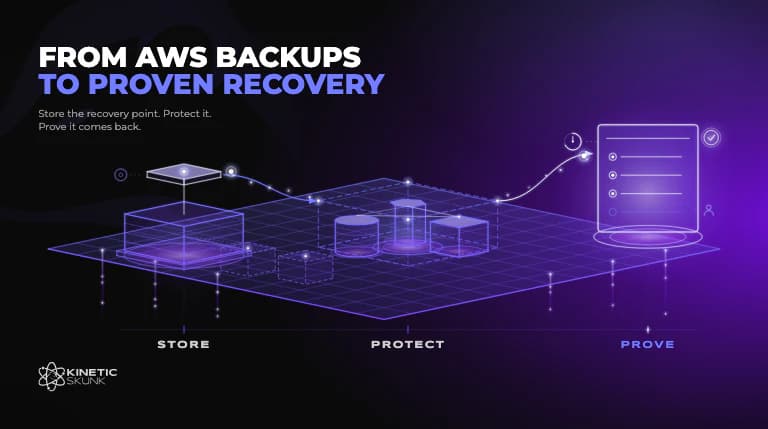
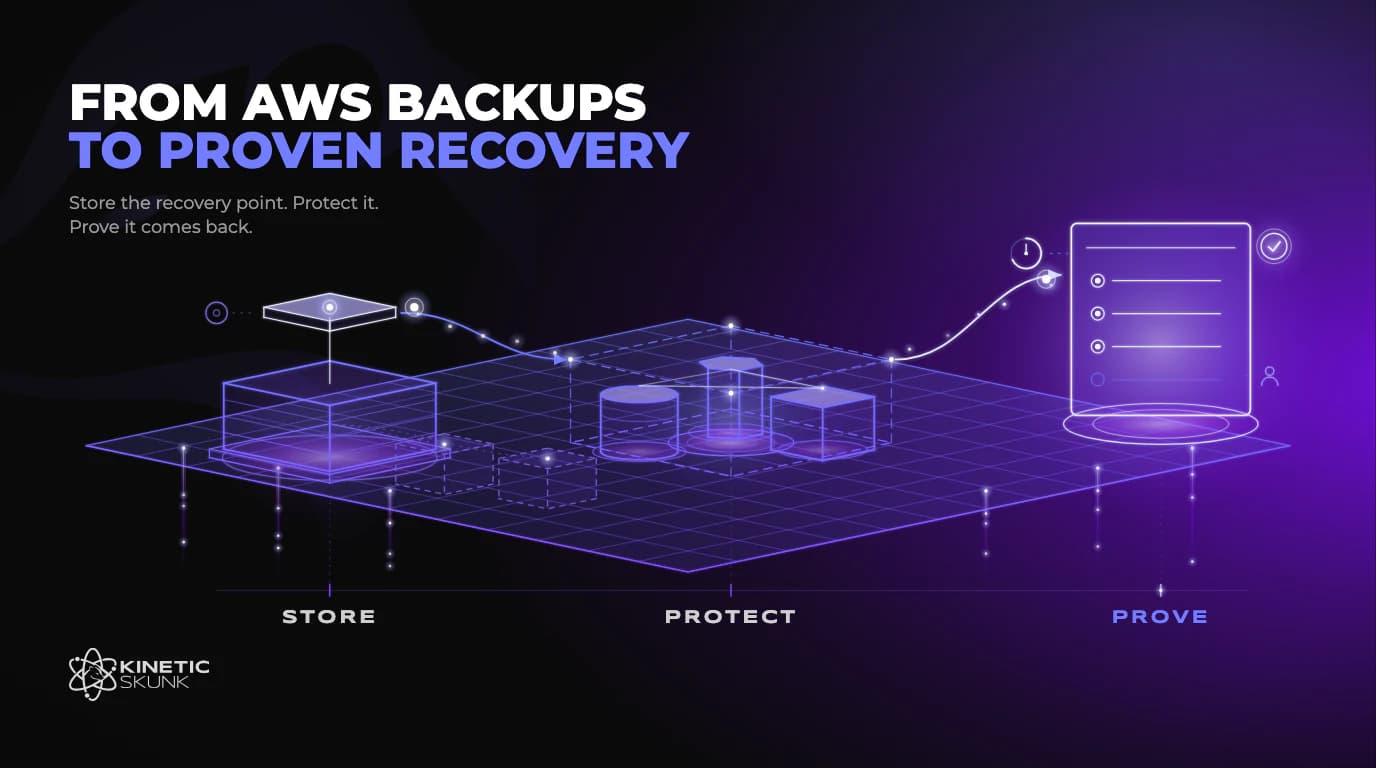
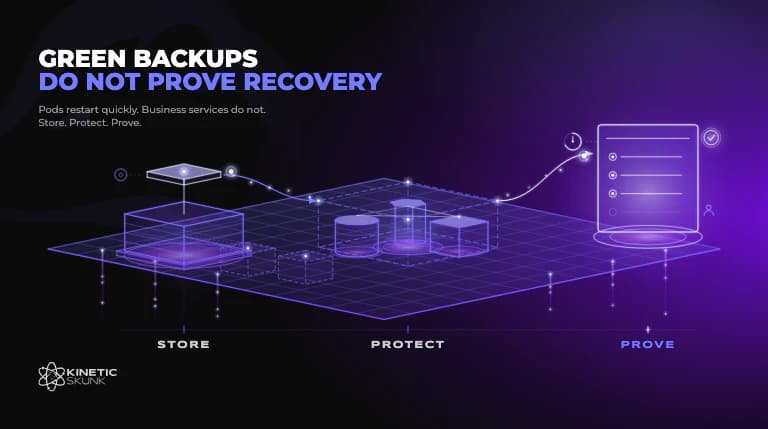
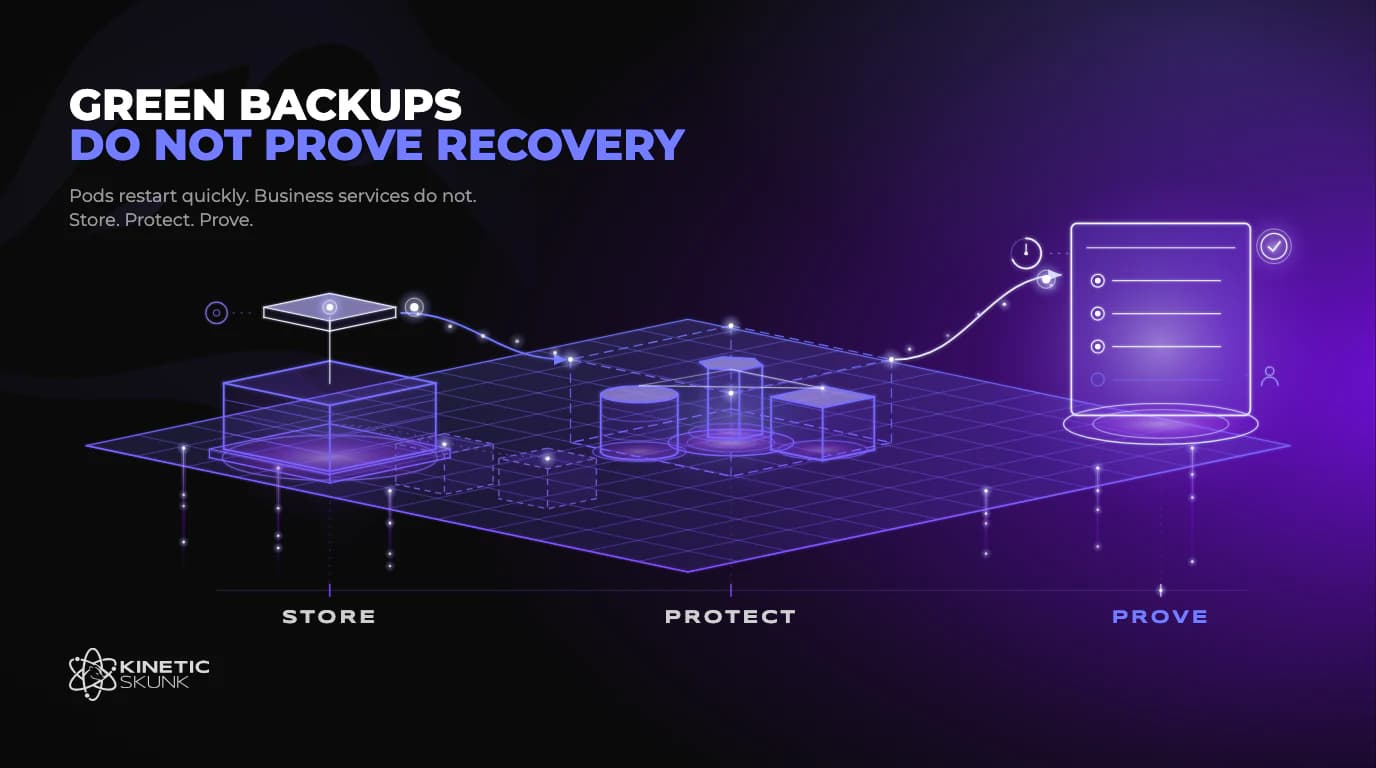
A Store, Protect, Prove framework for Amazon EKS and Amazon ECS recovery
Define the business service, not the cluster
- Start by naming the complete business service, the payment flow, patient workflow, customer portal, or reporting platform, that the EKS or ECS application supports, not the orchestration layer underneath it.
- That service usually depends on more than the cluster or task definition: databases such as Amazon RDS or Amazon Aurora, Amazon DynamoDB tables, Amazon S3 buckets, container images in Amazon ECR, secrets and parameters, IAM roles, load balancing, DNS, certificates, infrastructure-as-code repositories, CI/CD pipelines, and external APIs.
- Ask which complete business services would cause material customer, operational, financial, or compliance impact if they could not be recovered. That question, not the platform diagram, sets the recovery boundary.

Know what Amazon EKS actually protects
- AWS Backup can protect Amazon EKS cluster state together with persistent storage attached through persistent volume claims, including supported Amazon EBS, Amazon EFS, and Amazon S3 resources, grouped into a single composite recovery point.
- AWS Backup can restore that composite recovery point into an existing target cluster, create a new target cluster, or restore individual namespaces, and restores are non-destructive so they do not overwrite existing objects.
- That capability does not cover everything the business service needs. External databases, IAM configuration, network dependencies, certificates, CI/CD artefacts, third-party integrations, and application acceptance tests usually still need their own protection and recovery procedures.

Know what Amazon ECS actually protects
- An Amazon ECS task definition describes how a task should run, its container image, CPU and memory, networking mode, logging, volumes, command, and IAM role. An ECS service then keeps the desired number of tasks from that definition running.
- ECS recovery is really about recreating and reconnecting the service, not backing up the containers. The containers themselves are replaceable runtime instances.
- Recovery depends on whether the organisation can recreate the service definition and reconnect it to usable data, identities, secrets, networks, and external dependencies, including container images made available through Amazon ECR replication.

Set recovery outcomes before you choose controls
- Agree the recovery time objective and recovery point objective for the workload itself, not a generic platform standard. AWS describes RTO as the maximum acceptable delay before service is restored, and RPO as the maximum acceptable data loss window.
- Alongside RTO and RPO, define recovery priority, recovery location, minimum service level, data-validation and security criteria, evidence requirements, test frequency, and named ownership.
- A lower RTO or RPO is not automatically better. It usually costs more in engineering effort, automation, duplication, and operational overhead, so choose objectives that reflect business impact, then verify the architecture can meet them.
Store, govern what must be recoverable
- Build an inventory that connects every business service to its owning team, its AWS account, its application definitions, its persistent state, its external dependencies, its RTO and RPO, its protection method, and its most recent test evidence.
- AWS Backup can centralise protection policies and recovery points, and cross-account management through AWS Organizations can standardise and monitor backup policies across accounts, but centralisation alone is not the goal.
- The outcome that matters is traceability, can every critical business service be connected to a documented and owned recovery method, with no resource falling outside protection because of a missing tag or a manual process?
Protect, reduce the risk of losing the recovery path itself
- Recovery can still fail even when backups exist, if the container image is unavailable, the deployment repository is unreachable, a required KMS key cannot be used, secrets have not been recreated, or IAM roles point at resources that no longer exist.
- Controls such as cross-account and cross-Region backup copies, segregated administrative access, Amazon ECR image replication, protected infrastructure-as-code repositories, and monitoring for failed backup jobs protect the means of reconstruction, not only the data.
- AWS Backup Vault Lock in compliance mode can make recovery points immutable once the grace period ends, which strengthens protection against deletion, but the retention design needs care, locked recovery points cannot be removed early.
Prove, three levels of evidence, mapped to your maturity band
- Level 1, backup evidence, shows recovery points were created on schedule, backup job completion, recovery-point age, retention status, and resource coverage.
- Level 2, restore evidence, shows a selected resource was actually restored, restore-job completion, restore duration, target environment, and any errors or skipped resources. AWS Backup restore testing can schedule and record this automatically.
- Level 3, application-recovery evidence, shows the business service worked after recovery, data-integrity checks, authentication and dependency connectivity, transaction or workflow validation, observed RTO and RPO, and a named test owner. This is the level that turns technical activity into buyer confidence.
- The Store, Protect & Prove maturity assessment maps directly onto these three levels. Exposed usually means Level 1 evidence is patchy or missing. Basic Protection means Level 1 is established and Level 2 is starting. Managed Recovery means Level 1 and Level 2 are established and Level 3 is emerging. Recovery Assured means all three levels are produced, retained, and kept current.

Common mistakes
Buying a backup product before defining the business service
Consequence: This often creates strong technical coverage for some resources while leaving important dependencies, such as secrets, DNS, or external APIs, outside the recovery design.
Avoidance: Name the complete business service and its dependencies first, then choose backup, replication, or recovery controls that match the boundary.
Treating Amazon EKS and Amazon ECS as the same recovery problem
Consequence: They share application-level concerns, but their orchestration state and reconstruction processes differ enough that one recovery runbook rarely fits both.
Avoidance: Design separate recovery models for EKS and ECS workloads, then align them at the business-service and evidence level.
Defining recovery around the cluster instead of the business outcome
Consequence: The cluster is part of the platform. A payment, clinical, financial, or operational service is the actual recovery outcome customers and auditors care about.
Avoidance: Set the recovery boundary at the business-service level and treat the cluster as one dependency inside it.
Accepting infrastructure health as application proof
Consequence: Running pods or healthy ECS tasks are necessary technical signals, but they are not sufficient business acceptance criteria.
Avoidance: Add application-level validation, data-integrity checks, and transaction tests to every representative recovery test.
Selecting RTO and RPO without testing them
Consequence: Targets that have never been measured may not reflect real data volume, automation, dependencies, or operational constraints.
Avoidance: Run a representative recovery test and record the observed RTO and RPO against the agreed target before relying on it.
Running one successful test and declaring the problem solved
Consequence: Application architecture, data volume, platform configuration, and dependencies change, so recovery evidence goes stale unless testing repeats.
Avoidance: Schedule recovery tests on a fixed cadence and refresh the evidence pack every time, not only after the first pass.
Best practices
- Name the business service and its full dependency chain before choosing backup or recovery tooling.
- Set RTO, RPO, recovery priority, recovery location, and minimum service level for each critical workload, with business sign-off.
- Keep an inventory that connects every business service to its owner, its protection method, and its most recent test evidence.
- Protect the means of reconstruction, images, secrets, IAM roles, infrastructure-as-code, and DNS, not only the backed-up data.
- Run representative recovery tests that include application and business validation, not only infrastructure health checks.
- Retain evidence in a location accessible to leadership, security, compliance, and incident-response teams, and repeat testing on a fixed cadence.
Tools and processes
- AWS Backup, including Amazon EKS support and restore testing
- AWS Backup Vault Lock and AWS Backup Audit Manager
- Amazon ECR cross-Region and cross-account replication
- AWS Organizations for cross-account backup policy management
How to get started
- Score your current position with the Store, Protect & Prove Backup & Recovery Assessment, ten questions, about three minutes, no AWS access required.
- Name the business services in scope and confirm which dependencies sit outside your current Amazon EKS or Amazon ECS backup coverage.
- Compare your assessment band against the evidence level you can currently produce, backup, restore, or application-recovery.
- Decide whether internal remediation, a focused recovery-readiness engagement, or ongoing managed recovery operations fits your gap and your team's capacity.
- Run one representative recovery test for a business-critical EKS or ECS service and record the result as your first evidence artefact.
Start with the assessment and one representative test on your highest-impact service before committing to an estate-wide recovery programme.
How KineticSkunk helps
KineticSkunk works with technology and platform teams to assess, design, implement, and operationalise AWS recovery capability for container-based applications, treating Amazon EKS and Amazon ECS as part of a wider business-service recovery model rather than a standalone backup task.
The Store, Protect & Prove engagement runs inside your AWS environment over two to four weeks and delivers a governed backup foundation, a tested recovery path with observed evidence, operational visibility, and clear runbooks and ownership, replacing undocumented confidence with a repeatable recovery practice.
Running containers is not the same as proving recovery. Amazon EKS and Amazon ECS give you strong building blocks, but the evidence that a complete business service can recover still has to be designed, tested, and retained on purpose. If you want to think through the gap before you act, read the Prove It or Lose It guide or explore the Store, Protect & Prove approach.
Frequently asked questions
AWS Backup can protect Amazon EKS cluster state and supported persistent storage attached through persistent volume claims. A complete application may also depend on external databases, container images, IAM configuration, networking, secrets, certificates, and third-party services that need their own recovery controls.
AWS Backup can restore EKS resources into an existing target cluster or create a target EKS cluster with a limited set of options. It also supports namespace-level restores, and existing objects in the target cluster are not overwritten.
ECS recovery is generally based on preserving and recreating task definitions, services, infrastructure, networking, IAM configuration, secrets, and container images, while separately protecting the application's persistent data. The recovery process should then validate the complete service.
No. A task definition describes how ECS tasks should run, including their container image, compute, networking, volumes, logging, and IAM role. It is an important reconstruction artefact, but it does not protect the application's external data or prove that the complete service can recover.
Not necessarily. The complete elapsed time must be measured from recovery initiation until the required service is usable, and resource restore time may be only one part of that process.
No. Backup compliance can demonstrate that defined controls such as frequency, retention, or encryption are being followed. Recoverability requires restore testing and application-level validation.
The frequency should reflect business criticality, architecture changes, data growth, customer requirements, and the organisation's risk profile. Tests should also repeat after significant changes to the application, platform, or recovery procedure.
Sources
- AWS Backup: Amazon EKS backups
- AWS Backup: Restore an Amazon EKS cluster
- AWS Backup: Restore testing
- AWS Backup: Restore testing validation
- AWS Backup: Vault Lock
- AWS Backup Audit Manager
- Amazon ECS: Task definitions
- Amazon ECR: Private image replication
- AWS Well-Architected Reliability Pillar: Disaster recovery objectives
- AWS Well-Architected Framework: REL09-BP04, periodic recovery testing anti-patterns
- AWS Data Protection and Recovery