What is it?
Backup and recovery readiness is the demonstrated ability to restore a workload, its data, and its dependencies to an acceptable service level inside agreed recovery time and recovery point objectives, not merely the existence of a stored recovery point. Store, Protect & Prove is KineticSkunk's fixed-scope engagement that establishes this readiness inside a customer's AWS environment over two to four weeks, using AWS Backup, AWS Backup restore testing, and related AWS services as the technical foundation.
Technology and platform leaders are increasingly asked to produce recovery evidence with little warning, during enterprise onboarding, a compliance review, or straight after an incident, and "we have backups" no longer satisfies that question. The AWS Well-Architected Framework recommends periodically recovering data to confirm that restoration is possible, that the data is usable, and that recovery performance matches defined RTO and RPO expectations, which means recovery objectives need to be tested against observed results rather than left as documentation.
Use this guide when your organisation runs workloads on AWS, has some form of backup in place, and needs a clear, working model for turning that backup activity into evidence that recovery actually works. It also applies before a customer, auditor, or board asks the question directly, since building the evidence in advance costs less than assembling it under pressure.
Why it matters
Risks
- Treating a completed AWS Backup job as proof of recoverability hides the real gap until a customer, auditor, or incident forces the question, at which point "we have backups" is not an answer.
- Backup ownership spread across several teams, with recovery reports assembled manually when requested, means nobody can produce evidence quickly when it is needed.
- A database restore can succeed while the wider application stays down, because identity, network configuration, secrets, DNS, container images, and third-party integrations sit outside the restored resource.
Costs
- Retrofitting recovery evidence after a customer, auditor, or board asks for it takes longer and costs more than building the evidence into the recovery design from the start.
- Fragmented protection across AWS accounts and workloads means some resources are over-protected while others carry undetected risk, which wastes spend without closing the actual gap.
Operational impact
- Restore testing that is inconsistent or limited to a handful of systems leaves most of the estate with an unverified recovery path, no matter how complete the backup coverage looks on a dashboard.
- RTO and RPO values that were set once and never tested are technical settings inherited from a template, not business-approved commitments the organisation can stand behind.
Strategic impact
- Cloud environments keep changing, new services deployed, data volumes growing, permissions modified, dependencies evolving, so recovery testing has to repeat at a cadence set by workload criticality and risk, not run once and stop.
- Customer, audit, and board expectations for recovery evidence are forming faster than most organisations' internal proof practices, which is what turns an internal gap into an external liability.
The Store, Protect & Prove engagement, in four phases
Backup is not the same as recoverability
- A backup is a stored recovery point. Recoverability is the demonstrated capability to use that recovery point, together with procedures, infrastructure, and people, to restore an acceptable service within defined business constraints. AWS Backup makes it possible to centralise and automate protection across supported services, and its restore testing capability can periodically evaluate restore viability and record restore-job duration, but recovery confidence still depends on decisions outside the backup job itself.
- Those decisions include workload criticality, dependency mapping, restore validation, ownership, monitoring, evidence retention, and operational procedure, none of which a green backup job confirms on its own. The AWS Well-Architected Framework treats this distinction directly, recommending periodic recovery of data to verify that restoration is possible, that data is usable, and that recovery performance aligns with the stated RTO and RPO, rather than assuming a documented target will hold under pressure.
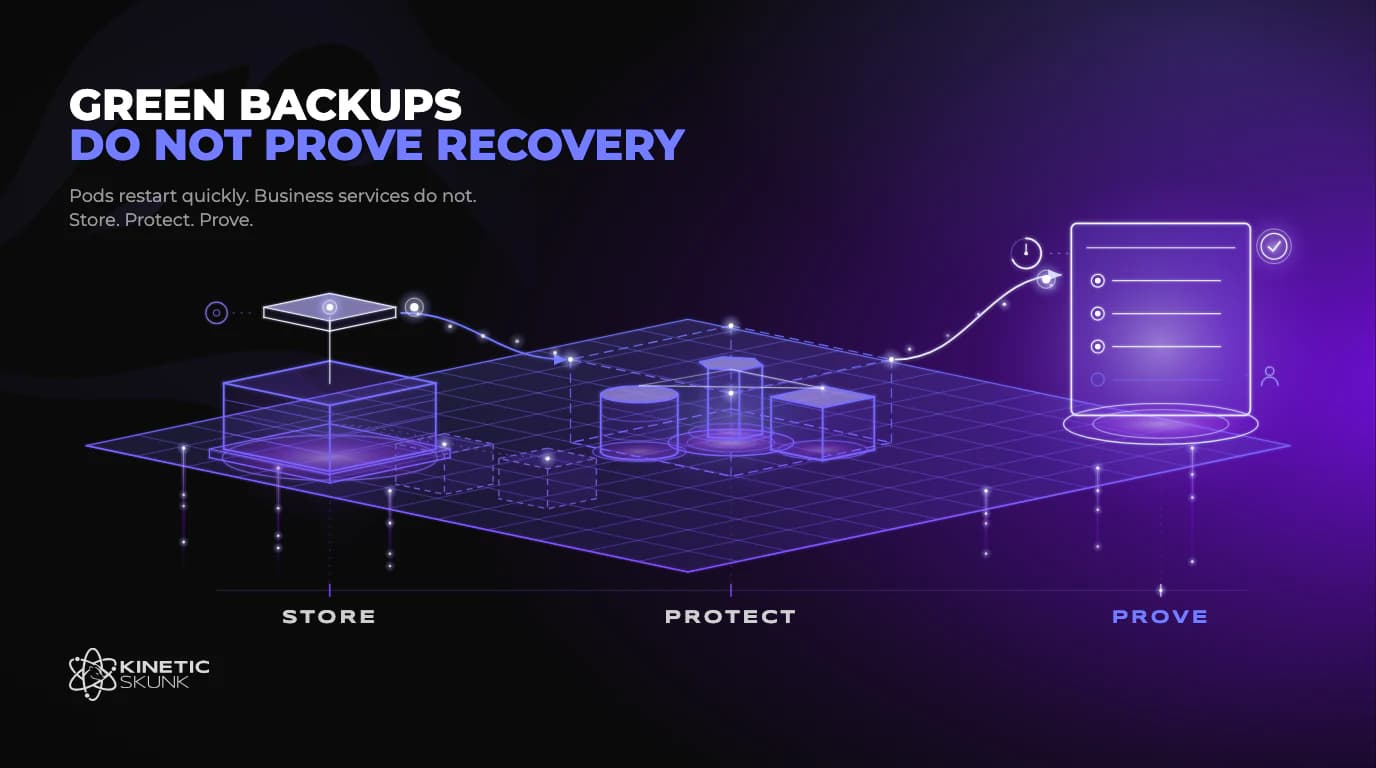
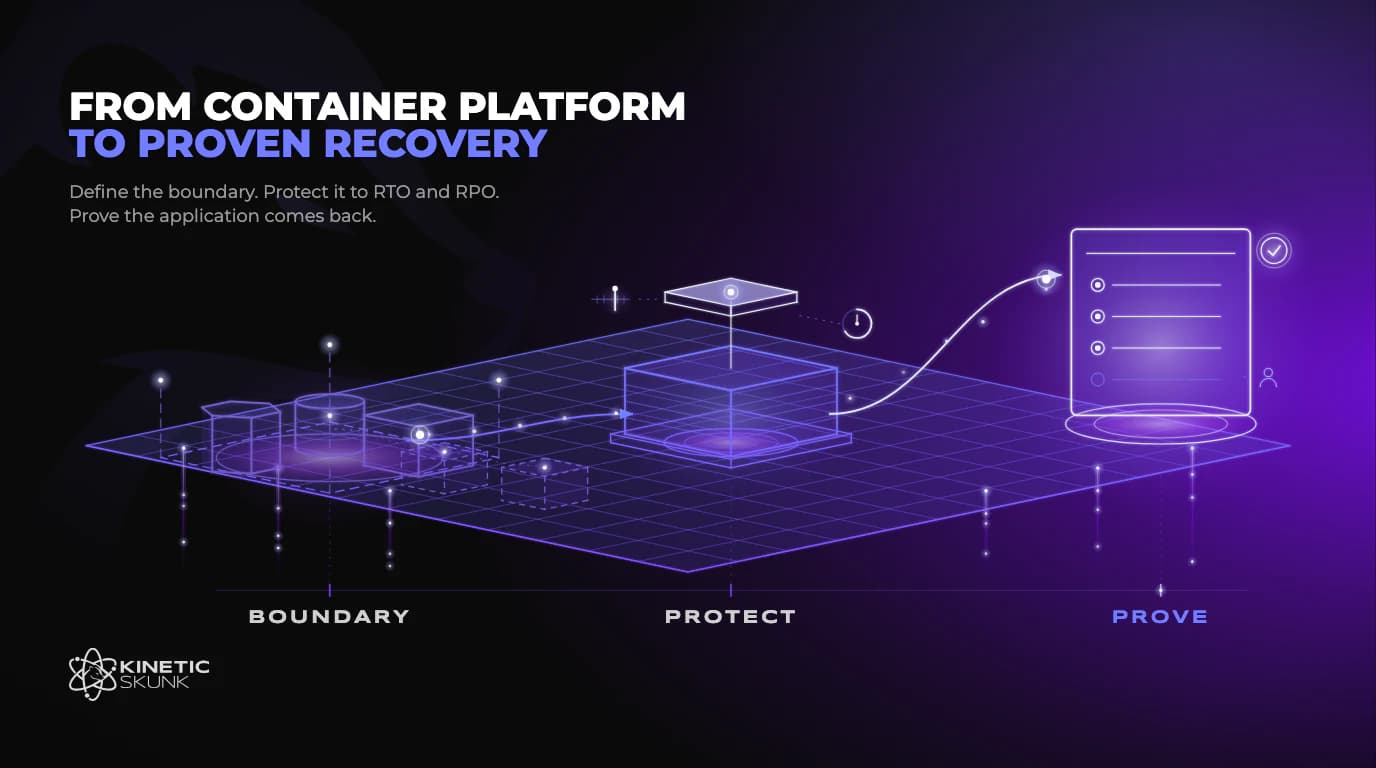
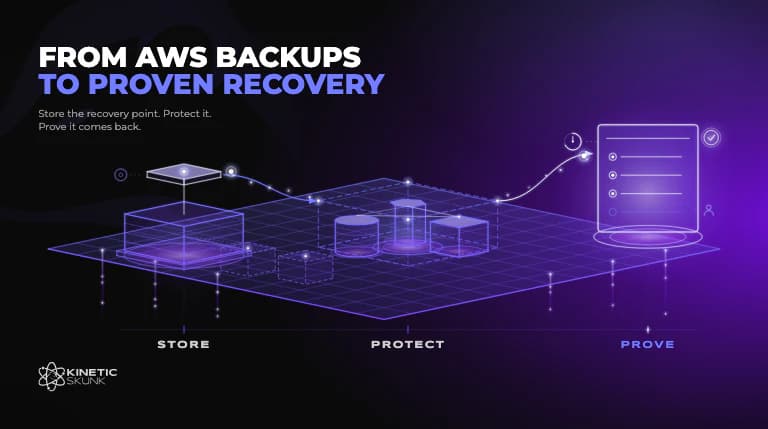
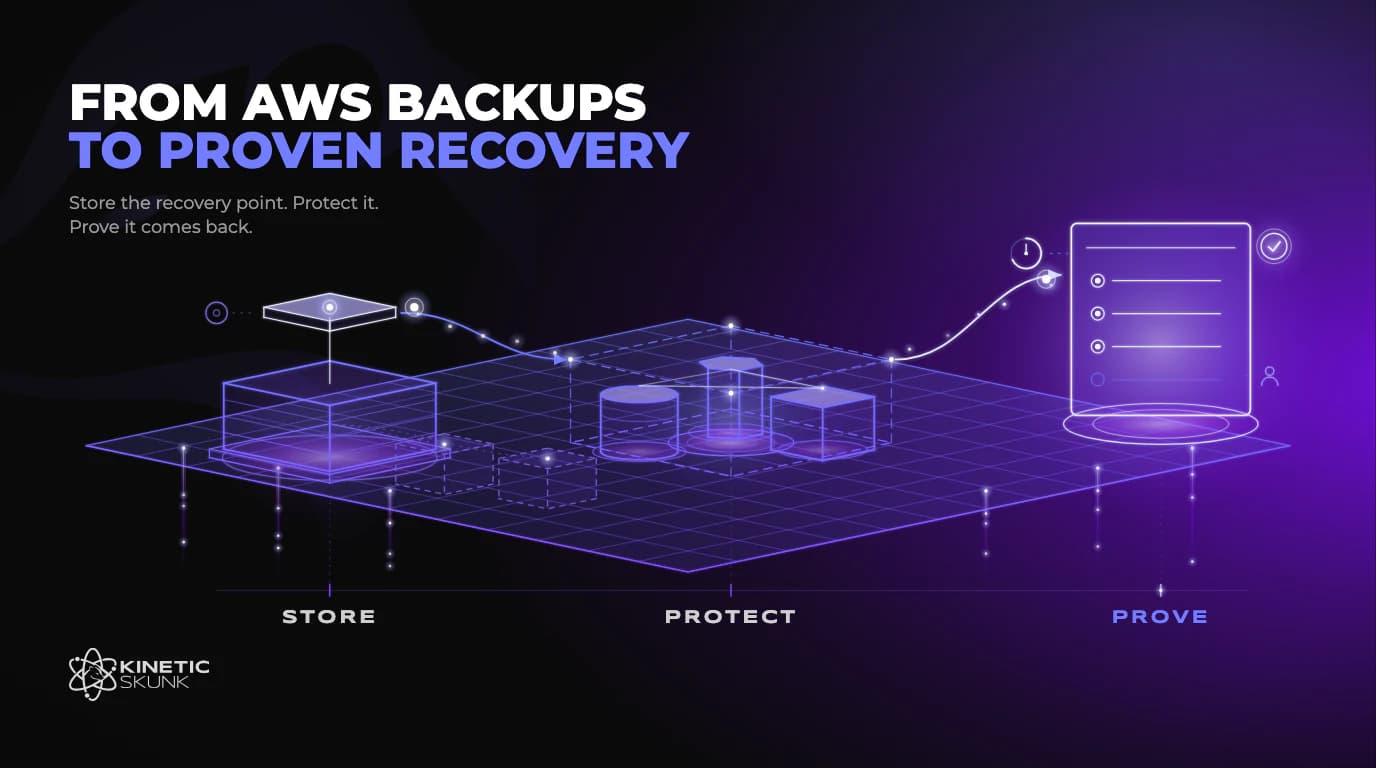
- Store, Protect & Prove turns that principle into a practical operating model, moving an organisation from a backup job that reports success to recovery evidence that a customer, auditor, or board can actually rely on.

Phase 1, discover what must recover
- The engagement starts with the business question, not an AWS service configuration. KineticSkunk identifies the recovery pressure driving the work, a customer or partner requesting documentation, an enterprise onboarding review, audit or regulatory scrutiny, an untested RTO and RPO, a recent failed restore or incident, or backup ownership spread across teams with reports assembled manually, and that pressure sets the scope. A FinTech platform preparing for due diligence needs different emphasis to a HealthTech platform protecting sensitive health information and connected clinical systems, so no single generic backup policy fits every case.
- From there, the assessment covers recovery pressure, critical workloads, the AWS estate, the current protection model, and operational ownership, asking which services must recover first, which data sources are authoritative, which dependencies have to be available before an application can function, and whether RTO and RPO values are business-approved or simply inherited technical settings.
- This phase creates a clear relationship between business criticality, recovery expectations, and AWS configuration. Without it, teams can optimise backup completion rates while still protecting the wrong resources, retaining data for the wrong period, or testing workloads that do not represent the real operational risk.

Phase 2, establish a governed backup foundation
- The second phase strengthens how backup protection is defined and managed. Depending on the environment and scope, this can include backup plans and schedules, retention and lifecycle rules, resource-selection and tagging patterns, coverage across supported AWS resources, backup vault design, AWS Key Management Service encryption arrangements, cross-account or cross-region copies, access controls and separation of duties, AWS Backup Vault Lock where stronger retention enforcement is appropriate, monitoring and reporting requirements, and ownership and escalation procedures.
- The purpose is not to add complexity indiscriminately. The protection model should reflect workload value, recovery objectives, threat scenarios, and operational capacity, and a technically strong design makes the trade-offs explicit rather than hiding them. Cross-region copies can provide geographic separation, but they also affect cost, data residency, and recovery procedure. Vault Lock can strengthen retention by preventing early deletion, including by privileged users, but locked recovery points cannot simply be removed before their lifecycle completes, so the retention design needs care.
Phase 3, select representative recovery paths to validate
- This is where configured protection starts becoming evidence. Representative workloads are selected for restore testing on a risk basis rather than arbitrarily, a critical database, a shared file system, an application server, an object-storage dataset, or another resource whose loss would materially affect operations.
- The selection matters because a restore test only proves what it actually tests. Choosing workloads that reflect real operational risk, rather than whichever resource is easiest to restore, is what makes the resulting evidence credible to a customer, auditor, or board asking the harder question.
What a representative restore test has to prove
- A useful restore test examines several layers, not just whether the job completed. First, can AWS initiate and complete the restore, confirming the recovery point is available, permissions are correct, required restore metadata exists, and AWS Backup restore testing can automate and record the result. Second, is the restored data valid, checking that expected records or objects are present, the data can be read by the intended service, encryption and key access work, the restore point falls inside the required RPO, and integrity checks pass.
- Third, can the wider service recover, since applications depend on more than one stored resource, identity, network configuration, secrets, infrastructure definitions, container images, DNS, external services, and configuration data can all determine whether a recovered workload actually returns to service. A database restore can succeed while the application recovery stays incomplete, which is why Store, Protect & Prove never equates a green restore job with full disaster recovery, and states exactly what was validated and what remains out of scope.
- Fourth, how did the actual recovery compare with expectations, recording observed restore duration, manual steps, delays, errors, and dependencies so the stated RTO and RPO can be checked against demonstrated capability rather than a target written in a policy. Where results fall short, the engagement identifies whether the issue lies in architecture, backup design, data volume, permissions, automation, documentation, ownership, or the recovery objective itself.

Phase 4, make recovery evidence operational
- Evidence loses value when it exists only in one engineer's terminal history or an isolated test ticket. The final phase makes recovery information easier to find, interpret, and reuse, covering operational visibility, recovery records, runbooks, ownership, and team handover, so the outcome answers questions such as which critical resources are protected, when the last successful backup and the last representative restore test ran, what was restored and validated, how long recovery took, whether the result supported the stated RTO and RPO, which gaps remain, and where an authorised stakeholder can find the evidence.
- AWS Backup Audit Manager can assess backup-policy compliance against defined controls, including backup frequency and retention, and produce reports covering backup activity and compliance status. Those reports contribute useful evidence, but they should never be presented as proof that an entire application recovered successfully, security controls, policy compliance, and tested recoverability are related forms of assurance, not substitutes for one another.

Evidence is an operating discipline, not a one-time report
- The objective is not a report that becomes obsolete the day after delivery. It is an operating rhythm for protection, testing, evidence, and improvement, because cloud environments keep changing, new services deployed, data volumes growing, permissions modified, dependencies evolving, and each of those changes can quietly invalidate a result that was accurate the last time it was tested.
- AWS treats recovery testing and automation the same way, as an ongoing operational practice rather than a one-off configuration task, and the recovery testing cadence should reflect workload criticality, change frequency, customer expectations, and organisational risk. Store, Protect & Prove is explicit about what it does not claim, it is not a guarantee that no future restore can fail, not a replacement for complete disaster-recovery or business-continuity planning, not proof that every dependency was tested unless it was explicitly included, and not a security certification or a compliance opinion.
Common mistakes
Treating a completed AWS Backup job as proof of recoverability.
Consequence: The gap between "a recovery point exists" and "the workload can actually be restored" stays invisible until a customer, auditor, or incident forces the question, at which point there is no time left to close it quietly.
Avoidance: Run representative restore tests and record the results as separate evidence from backup job status, so recoverability is demonstrated, not assumed.
Applying one generic backup policy to every workload, regardless of criticality.
Consequence: Coverage looks complete on a dashboard while some resources are over-protected and others, often the ones that would cause the most damage if lost, carry undetected risk.
Avoidance: Scope protection and testing to the recovery pressure and business criticality identified during discovery, not a single retention and schedule template applied estate-wide.
Treating a successful restore job as proof of full application recovery.
Consequence: A database restore can complete while identity, network configuration, secrets, DNS, container images, or third-party integrations stay unrecovered, leaving the business service down even though the resource-level test passed.
Avoidance: State exactly what a restore test validated and what remained out of scope, and add dependency and service-acceptance checks to every representative test.
Presenting backup-policy compliance reports as recovery proof.
Consequence: AWS Backup Audit Manager can confirm that backup frequency and retention controls were followed, which is a different claim to confirming that the application actually came back online after a restore.
Avoidance: Keep compliance evidence and tested recoverability evidence clearly separate, and label each for what it actually demonstrates.
Treating one successful recovery test as a permanent guarantee.
Consequence: New services get deployed, data volumes grow, permissions change, and dependencies evolve, so evidence that was accurate at the last test can be wrong by the time anyone asks for it again.
Avoidance: Set a recovery testing cadence based on workload criticality and change frequency, and refresh the evidence pack every time, not only after the first pass.
Leaving backup ownership fragmented with recovery reports assembled manually on request.
Consequence: When a customer, auditor, or board member asks for recovery evidence, nobody can produce it quickly, and the delay itself reads as a lack of readiness.
Avoidance: Centralise ownership and reporting so recovery evidence is a standing, retrievable operational asset rather than something reconstructed under pressure.
Best practices
- Name business-critical services and data, and confirm existing RTO and RPO expectations, before selecting backup tooling or configuration.
- Map AWS accounts, regions, and data-bearing services in scope, including Amazon EC2, Amazon RDS, Amazon DynamoDB, Amazon S3, and Amazon EFS, so nothing sits outside the protection model by omission.
- Select representative workloads for restore testing on a risk basis, a critical database, a shared file system, or another resource whose loss would materially affect operations, not whichever is easiest to test.
- Validate restored data, not only infrastructure completion, checking that records are present, access works, encryption functions, and the restore point falls inside the required RPO.
- Check the wider service on every restore test, identity, network, secrets, DNS, and external dependencies, since a resource-level restore can succeed while the business service stays down.
- Record observed restore duration and outcomes against the stated RTO and RPO, and assign ownership for closing any gap the test reveals.
- Store recovery evidence somewhere an authorised stakeholder can retrieve it on demand, and repeat testing on a cadence set by workload criticality and change frequency.
Tools and processes
- AWS Backup, including backup plans, vaults, and cross-account or cross-region copies
- AWS Backup restore testing
- AWS Backup Vault Lock
- AWS Backup Audit Manager
- AWS Key Management Service for backup encryption
- AWS Organizations for cross-account backup policy management
How to get started
- Score your current position with the free Store, Protect & Prove Backup & Recovery Assessment, ten questions, about three minutes, no AWS credentials required.
- Name the recovery pressure driving the work, a customer request, an audit, a board question, an untested RTO and RPO, or a past incident, and let it set the scope.
- Gather what you already have, a list of business-critical services, current AWS Backup plans and retention settings, architecture and dependency information, and any previous restore-test records.
- Run one representative recovery test on your highest-priority workload and record duration, errors, and dependencies as your first piece of evidence.
- Compare the assessment result and the test outcome against your gap, then decide whether internal remediation, a focused Store, Protect & Prove engagement, or ongoing managed recovery support fits your scope and your team's capacity.
Start with the free assessment and one representative restore test on your highest-impact workload before committing to an estate-wide recovery programme.
How KineticSkunk helps
KineticSkunk works inside a customer's AWS environment to close the proof gap between backup activity and demonstrated recoverability, treating governance, restore validation, operational visibility, and evidence as one connected practice rather than separate projects.
The Store, Protect & Prove engagement runs for two to four weeks and delivers a governed backup foundation, tested recovery paths with observed evidence, operational visibility through reporting and alerts, and clear runbooks and ownership, replacing undocumented confidence with a repeatable recovery practice.
A backup job that turns green every night is not the same claim as a business service that can actually come back online. If you run containerised workloads, read How to Prove Recovery for Amazon EKS and Amazon ECS Applications next, or explore the full Store, Protect & Prove approach.
Frequently asked questions
No. It proves that the backup job created a recovery point successfully. Recovery testing is still needed to confirm that the resource can be restored, and that the resulting data or service meets defined validation criteria.
A backup is a stored recovery point. Recoverability is the demonstrated capability to use that recovery point, together with procedures, infrastructure, and people, to restore an acceptable service inside agreed recovery time and recovery point objectives.
It can compare stated recovery expectations with observed results for the representative workloads and scenarios included in scope. It should not be used to claim that every workload meets its RTO and RPO unless each relevant recovery path has actually been tested.
No. It is a technical and operational recovery-readiness engagement. The resulting evidence may support customer, audit, or internal-risk discussions, but it does not provide legal assurance or replace an independent certification or audit.
No. It can assess backup-policy compliance against defined controls, such as backup frequency and retention, and produce reports on backup activity. Those reports are useful evidence, but they do not confirm that a restored application actually returns to service.
The engagement typically runs for two to four weeks inside the customer's AWS environment, covering discovery, governed backup protection, representative restore validation, and operational handover.
Yes. The recovery model can use AWS Organizations, centralised AWS Backup policies, and cross-account patterns where they fit the organisation's architecture and risk requirements. The exact account and workload scope is confirmed during discovery.