What is it?
Backup confidence on Kubernetes is the belief that completed backup jobs protect the estate. Application recoverability is the demonstrated ability to restore the complete service, including persistent data, managed databases, object storage, queues, identities, keys, images, DNS, certificates, networking and third-party integrations, to an acceptable state inside agreed recovery objectives.
Technology leaders hear "the backups are green" in almost every resilience discussion. That sentence stops being enough when a customer asks for resilience evidence, an auditor requests proof of recovery capability, or an incident forces a restore that depends on more than cluster state.
Use this guide when you run containerised workloads on managed platforms and need a short provocation that separates backup activity from recovery outcomes before you go deeper into EKS versus ECS prove-recovery detail or an AWS Backup engagement walkthrough.
Why it matters
Risks
- Treating a green backup job as proof of recoverability hides the gap until procurement, audit or an incident forces the question.
- A successful restore of one layer can leave the business service down because identities, secrets, images or external integrations sit outside the restored object.
- Recovery that depends on a single engineer cannot be presented as organisational evidence.
Costs
- Assembling recovery evidence under customer or audit pressure costs more than building it into platform operations in advance.
- Over-investing in backup tooling while under-investing in representative restore validation wastes spend without closing the proof gap.
Operational impact
- Managed platforms reduce operational complexity without deciding RTO, RPO, dependency order or validation criteria.
- Restore tests that stop at pods Running leave FinTech and HealthTech workflow outcomes unproven.
Strategic impact
- Proven recoverability is becoming an operational requirement for regulated and business-critical container platforms, not a technical aspiration.
- Customer and auditor expectations for recovery evidence are forming faster than most organisations' internal proof practices.
From green backups to proved recovery
Green backups are not recoverability
- A backup tells you that recovery points exist. Recoverability shows that the complete application and its dependencies are protected, recovery points are usable, infrastructure can be recreated, identities and keys work during recovery, external services restore in the correct sequence, critical workflows are validated, measured RTO and RPO are achieved, and evidence exists to demonstrate those outcomes.
- Simply seeing Kubernetes pods reach a Running state is rarely sufficient. For a FinTech platform, recovery may need to demonstrate transaction integrity, reconciliation and auditability. For a HealthTech platform, it may need to prove patient data integrity, workflow continuity, identity controls and application safety. The business outcome, not the infrastructure, is the real measure of success.

Managed platforms keep recovery responsibility
- Managed container platforms reduce operational complexity. AWS operates the Amazon EKS control plane. Microsoft manages AKS. AWS and Red Hat jointly operate ROSA. Amazon ECS abstracts away container orchestration. Those services remove infrastructure work.
- They do not decide which applications are business critical, the RTO and RPO each service must achieve, how external databases and storage should be recovered, whether application data remains consistent after restoration, how customer-facing services are validated, or what evidence can be presented to customers, auditors and leadership. Those responsibilities remain with the organisation operating the workload.

Recovery gaps surface under business pressure
- Few organisations decide they need better recoverability because a backup dashboard changes colour. The conversation usually changes when an enterprise customer requests recovery evidence during procurement, an audit asks when the last representative restore was completed, leadership wants measured RTO and RPO rather than documented objectives, a ransomware exercise reveals production and backup systems share the same administrative boundary, or recovery depends on knowledge held by a single engineer.
- These situations do not create weaknesses. They expose weaknesses that already exist behind green backup status.

Store. Protect. Prove.
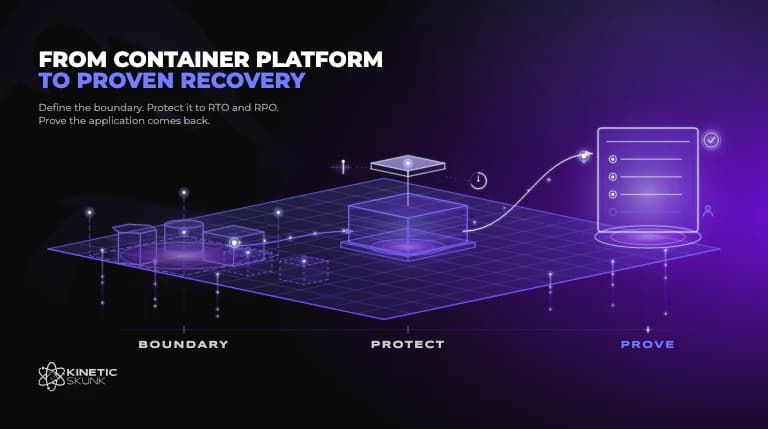
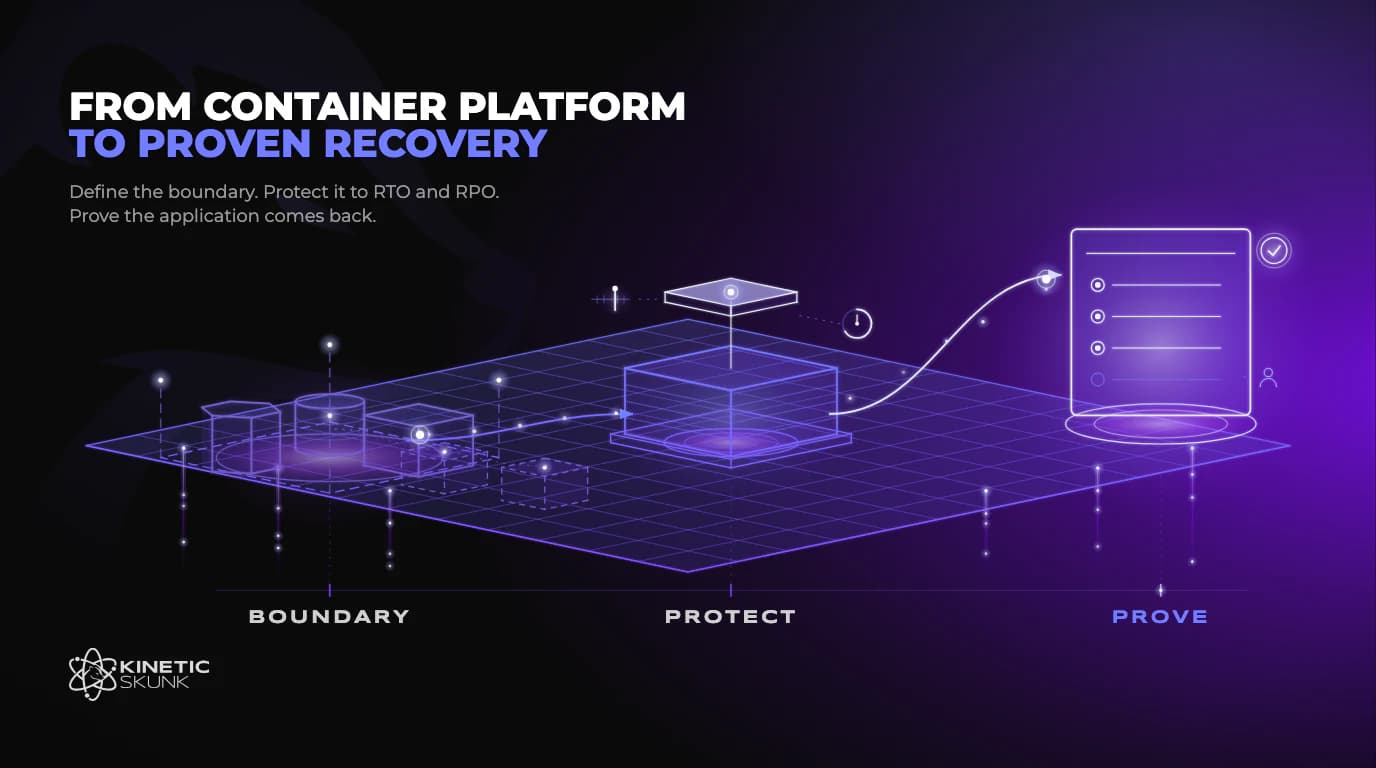
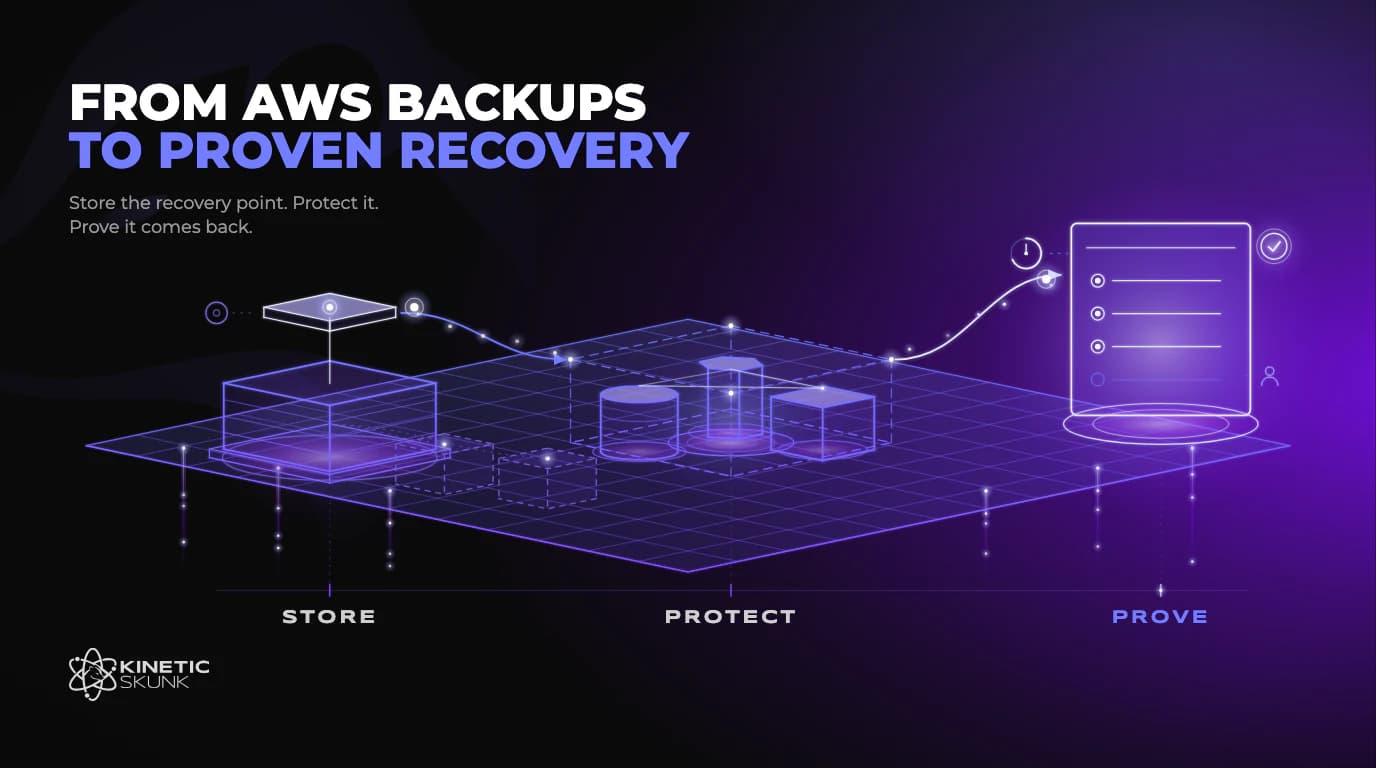
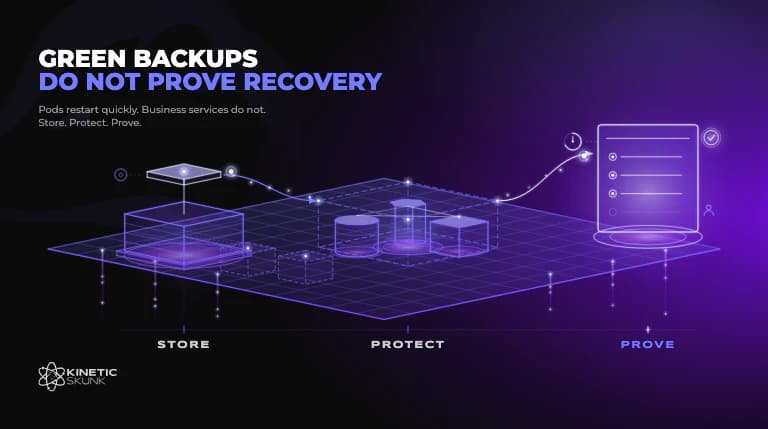
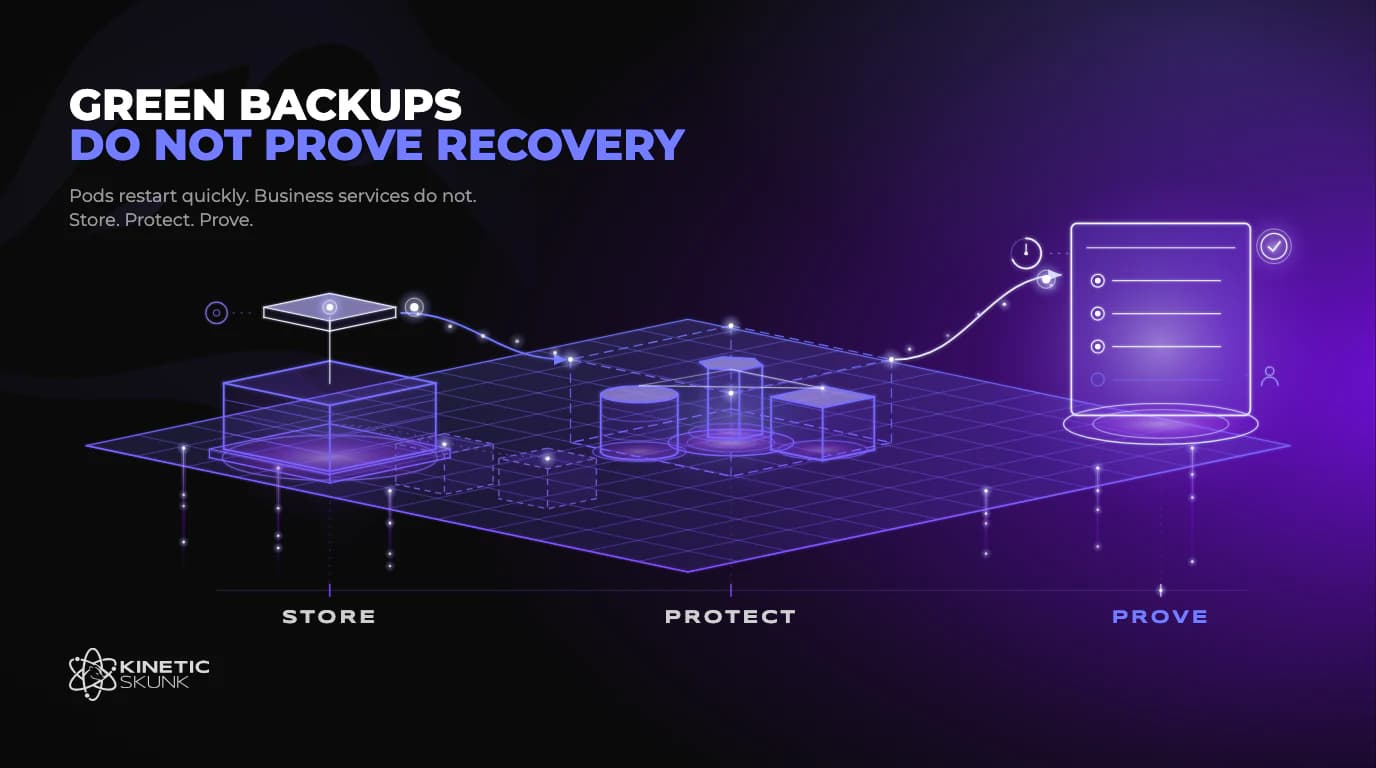
- At KineticSkunk, resilient recovery follows three practical steps. Store data according to its business value, location and obligations. Protect the complete application, not only cluster state, but also persistent data, external services, identities and operational dependencies. Prove that the business service can recover within the conditions customers, regulators and the organisation actually require.
- Many organisations have already invested in storage and protection. The greatest opportunity now is making recovery evidence part of normal platform operations instead of something assembled during an incident or audit.

Common mistakes
Equating a green backup job with proved application recovery.
Consequence: The gap stays invisible until procurement, audit or an incident forces the question, at which point there is no quiet window left to close it.
Avoidance: Keep backup activity evidence separate from restore-validation evidence, and record what each actually demonstrates.
Assuming the managed platform owns recovery outcomes.
Consequence: Criticality, RTO, RPO, dependency order, validation and evidence remain unowned while teams assume the vendor decided them.
Avoidance: Document organisational ownership for recovery objectives, dependency recovery and evidence retrieval.
Stopping validation when pods reach Running.
Consequence: Workflow integrity, identity controls and customer-facing acceptance stay unproven even though the cluster looks healthy.
Avoidance: Validate the complete business workflow in an isolated restore, not only infrastructure health.
Waiting for procurement or audit to request evidence.
Consequence: Evidence is assembled under pressure and the delay itself reads as a lack of readiness.
Avoidance: Make recovery evidence a standing operational asset that authorised stakeholders can retrieve on demand.
Leaving recovery knowledge with a single engineer.
Consequence: The organisation cannot produce evidence quickly, and recovery fails when that person is unavailable.
Avoidance: Codify runbooks, ownership and recorded restore results so evidence does not live in one terminal history.
Duplicating the full EKS versus ECS comparison in this provocation.
Consequence: Readers lose the short argument and miss the deeper hub when they need platform-specific detail.
Avoidance: Cross-link the prove-recovery hub for EKS and ECS depth, and the AWS Backup readiness sibling for engagement detail.
Best practices
- Name the containerised services with the greatest business impact if unavailable tomorrow.
- Map where each application's durable state actually lives, including data outside the cluster.
- Restore a representative service into an isolated environment and validate the complete workflow.
- Confirm identities, secrets, images and external dependencies cannot block recovery.
- Check whether production credentials can modify recovery copies.
- Store evidence of successful recovery where authorised stakeholders can retrieve it.
- Revisit testing cadence as platforms and dependencies change.
Tools and processes
- Amazon EKS, Amazon ECS, AKS, ROSA and related Kubernetes platforms
- Platform backup and restore tooling for cluster and application state
- Isolated restore environments and workflow validation checks
- Store, Protect & Prove Backup & Recovery Assessment
- Recovery evidence registers and runbooks
How to get started
- Score your position with the free Store, Protect & Prove Backup & Recovery Assessment.
- List the containerised services that would create the greatest business impact if unavailable tomorrow.
- Map durable state and external dependencies for the highest-impact service.
- Run one representative restore into an isolated environment and validate the business workflow.
- Compare the result with your stated RTO and RPO, then decide whether deeper EKS and ECS prove-recovery work or an AWS Backup readiness engagement is next.
Start with one high-impact service and one representative restore before expanding estate-wide.
How KineticSkunk helps
KineticSkunk helps organisations running regulated or business-critical container platforms close the gap between backup activity and demonstrated recoverability, without treating green dashboards as the finish line.
Teams leave with clearer ownership, representative restore evidence, and a Store, Protect & Prove operating model that answers customer and auditor questions with measured results.
Green backups are not the finish line for container platforms. For deeper Amazon EKS and Amazon ECS prove-recovery detail, read How to Prove Recovery for Amazon EKS and Amazon ECS Applications. For what a Store, Protect & Prove engagement delivers on AWS Backup, read AWS Backup and Recovery Readiness, or explore the full Store, Protect & Prove approach.
Frequently asked questions
No. They prove that recovery points are being created. Application recovery still needs representative restore validation across durable state, identities, images, networking and external dependencies.
No. They remove infrastructure work. Criticality, RTO, RPO, dependency recovery, validation and evidence remain with the organisation operating the workload.
Rarely. Business outcomes such as transaction integrity or clinical workflow continuity still need validation beyond cluster health.
This is the shorter provocation across Kubernetes platforms. That hub covers deeper Amazon EKS versus Amazon ECS prove-recovery detail.
That sibling walks through what a Store, Protect & Prove engagement delivers in AWS. This article is the container-platform provocation that leads into that engagement model.
Which services matter most if unavailable tomorrow, where durable state lives, when the last isolated restore ran, whether the complete workflow was validated, and where the evidence sits.
Sources
- AWS Well-Architected Reliability Pillar: Disaster recovery objectives
- AWS Backup: Restore testing
- How to Prove Recovery for Amazon EKS and Amazon ECS Applications
- AWS Backup and Recovery Readiness: What Happens in a Store, Protect & Prove Engagement
- Store, Protect & Prove
- AWS Data Protection and Recovery