What is it?
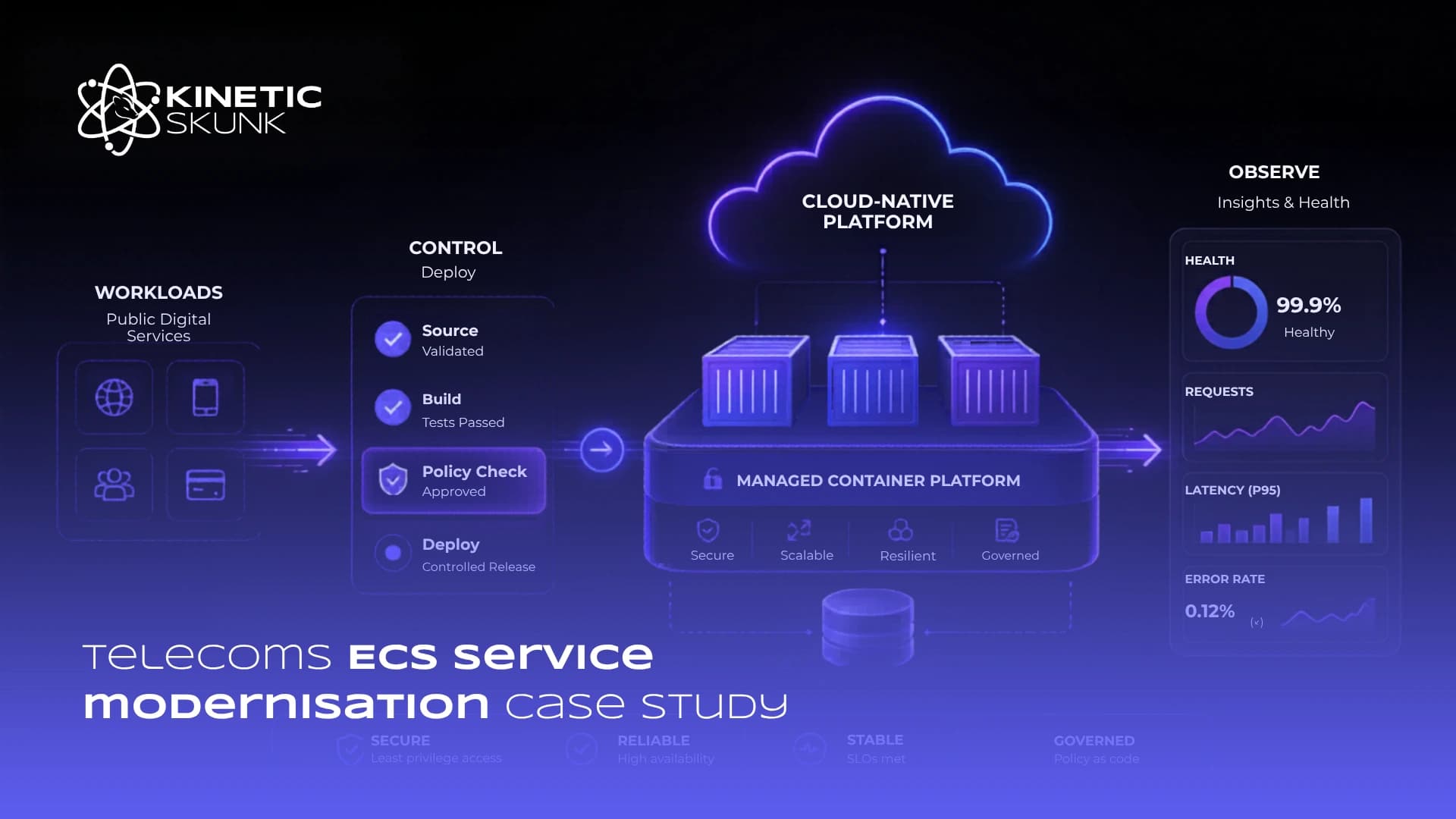
This case study covers how KineticSkunk modernised a public digital service for a telecoms operator by migrating from a monolithic architecture to AWS ECS, introducing container orchestration that improved deployment frequency, scaling, and operational resilience.
The telecoms operator ran a public-facing digital service on a monolithic platform where every release required coordinated downtime. Growing customer traffic and regulatory obligations demanded higher availability, faster releases, and the ability to scale individual services independently.
Use this approach when a telecoms or public-sector digital service has outgrown its monolithic architecture, requires zero-downtime deployments, and needs elastic scaling for variable customer-facing traffic without manual capacity planning.
Why it matters
Risks
- Monolithic releases require coordinated downtime windows that erode customer trust and breach availability commitments.
- Tightly coupled services mean a defect in one component can cascade and bring down the entire public-facing platform.
- Manual scaling processes cannot respond fast enough to traffic surges triggered by marketing campaigns or service incidents.
Costs
- Over-provisioned monolithic infrastructure inflates hosting costs during quiet periods without providing elasticity during peaks.
- Coordinated release windows consume engineering time in planning and communication rather than feature delivery.
- Extended incident recovery on monolithic platforms increases downtime costs and regulatory exposure for public digital services.
Operational impact
- Teams sharing a single deployment pipeline cannot release independently, creating bottlenecks as the service portfolio grows.
- Without container orchestration, scaling one service means scaling the entire monolith, wasting compute on idle components.
- Incident blast radius remains large when services share runtime, making root cause isolation slow and recovery unpredictable.
Strategic impact
- Telecoms competitors with decomposed architectures ship features faster and offer better uptime guarantees to regulators and customers.
- Managed container orchestration frees engineering capacity for customer-facing innovation rather than infrastructure maintenance.
- Container-based platforms attract and retain engineering talent who expect modern delivery practices and tooling.
How KineticSkunk modernised the telecoms public service with AWS ECS
Legacy platform assessment and service boundary identification
- The telecoms public service ran as a monolith where releases required coordinated downtime across customer-facing and back-office functions.
- KineticSkunk assessed the existing architecture to identify natural service boundaries suitable for decomposition and independent deployment.
- A phased migration plan prioritised customer-facing services that would benefit most from independent scaling and zero-downtime releases.
AWS ECS cluster design and networking
- ECS clusters were designed around the telecoms workload profile, with Fargate tasks for variable customer-facing traffic and EC2-backed capacity for predictable batch workloads.
- VPC networking, security groups, and service discovery were configured to isolate customer-facing services from internal back-office systems.
- Container images were stored in Amazon ECR with automated vulnerability scanning integrated into the build pipeline.
Service decomposition and deployment automation
- Customer-facing services were containerised incrementally, starting with the public API layer before progressing to notification and billing services.
- Blue-green deployment patterns on ECS enabled zero-downtime releases for public services with strict availability requirements.
- CI/CD pipelines automated image building, security scanning, and rolling deployment to ECS across development, staging, and production.
Outcomes and operational improvements
- Deployment frequency increased as teams released their services independently without coordinating downtime windows.
- Incident blast radius shrank because failures in one service no longer cascaded to unrelated components.
- ECS auto-scaling handled traffic variability from marketing campaigns and seasonal peaks without manual intervention.
- The team established a container platform that supports future service additions without requiring architecture redesign.
Common mistakes
Attempting to decompose all services simultaneously rather than migrating incrementally
Consequence: The migration stalls because complex stateful services block progress, and the team cannot demonstrate value until the entire monolith is replaced.
Avoidance: Start with stateless customer-facing services that containerise cleanly, deliver visible value early, and build migration confidence before tackling complex stateful workloads.
Running ECS tasks without health checks and circuit breakers between services
Consequence: A failing service consumes resources and propagates errors downstream, recreating the cascading failure pattern the migration aimed to eliminate.
Avoidance: Configure ECS health checks, load balancer target group thresholds, and inter-service circuit breakers from the first deployed service.
Treating container adoption as purely an infrastructure change without updating team structure
Consequence: Teams continue coordinating releases as if they share a monolith, losing the deployment velocity and independence that service decomposition enables.
Avoidance: Align team ownership to service boundaries so each team can release, monitor, and scale its services independently.
Best practices
- Identify natural service boundaries in the monolith before committing to a decomposition timeline.
- Design ECS task definitions with resource limits and health checks from the first deployed service.
- Use blue-green or rolling deployment strategies to achieve zero-downtime releases for public services.
- Integrate CI/CD pipelines with ECR and ECS early so deployment automation improves incrementally.
- Configure auto-scaling policies based on observed traffic patterns from the legacy platform.
- Maintain environment parity between development, staging, and production using infrastructure as code.
Tools and processes
- AWS ECS (Fargate and EC2) for managed container orchestration and task scheduling
- Amazon ECR for container image storage and automated vulnerability scanning
- Application Load Balancer for traffic routing, blue-green deployments, and health checks
- CI/CD pipelines for automated build, scan, and deployment to ECS across environments
- AWS CloudWatch and Container Insights for service-level observability and alerting
How to get started
- Audit the existing monolithic architecture to identify services suitable for independent deployment.
- Design ECS cluster topology with appropriate launch types, networking, and security for the workload profile.
- Containerise the first batch of customer-facing services and establish CI/CD pipelines for automated deployment.
- Configure blue-green deployment patterns and auto-scaling policies based on observed traffic patterns.
- Migrate remaining services incrementally, validating each phase against availability and performance baselines.
- Decommission legacy monolithic infrastructure once all production traffic runs on ECS.
If the immediate pressure is release velocity, start with CI/CD automation and independent deployment for customer-facing services. If the blocker is availability risk, start with blue-green deployments and health-check configuration. Both paths converge on a fully modernised telecoms service platform.
How KineticSkunk helps
KineticSkunk helps telecoms and public-sector organisations migrate from monolithic platforms to AWS ECS with phased service decomposition, deployment automation, and operational practices that reduce risk and accelerate feature delivery.
The client gained a scalable, resilient public digital service where deployments are zero-downtime, scaling is elastic, and the engineering team releases independently without coordinated downtime windows.
When you need help modernising telecoms services with AWS ECS, contact us or explore more case studies.
Frequently asked questions
ECS is simpler to operate for teams new to containers because AWS manages the orchestration layer, reducing the operational learning curve compared to Kubernetes on EKS.
Phased migrations typically take three to six months depending on service count and complexity, with early customer-facing value delivered within the first sprint cycle.
Yes. Blue-green patterns route traffic to new task sets only after health checks pass, so customers never hit an unhealthy deployment during the release window.
Auto-scaling means each service only consumes resources proportional to its demand, reducing the over-provisioning common with monolithic infrastructure.