What is it?
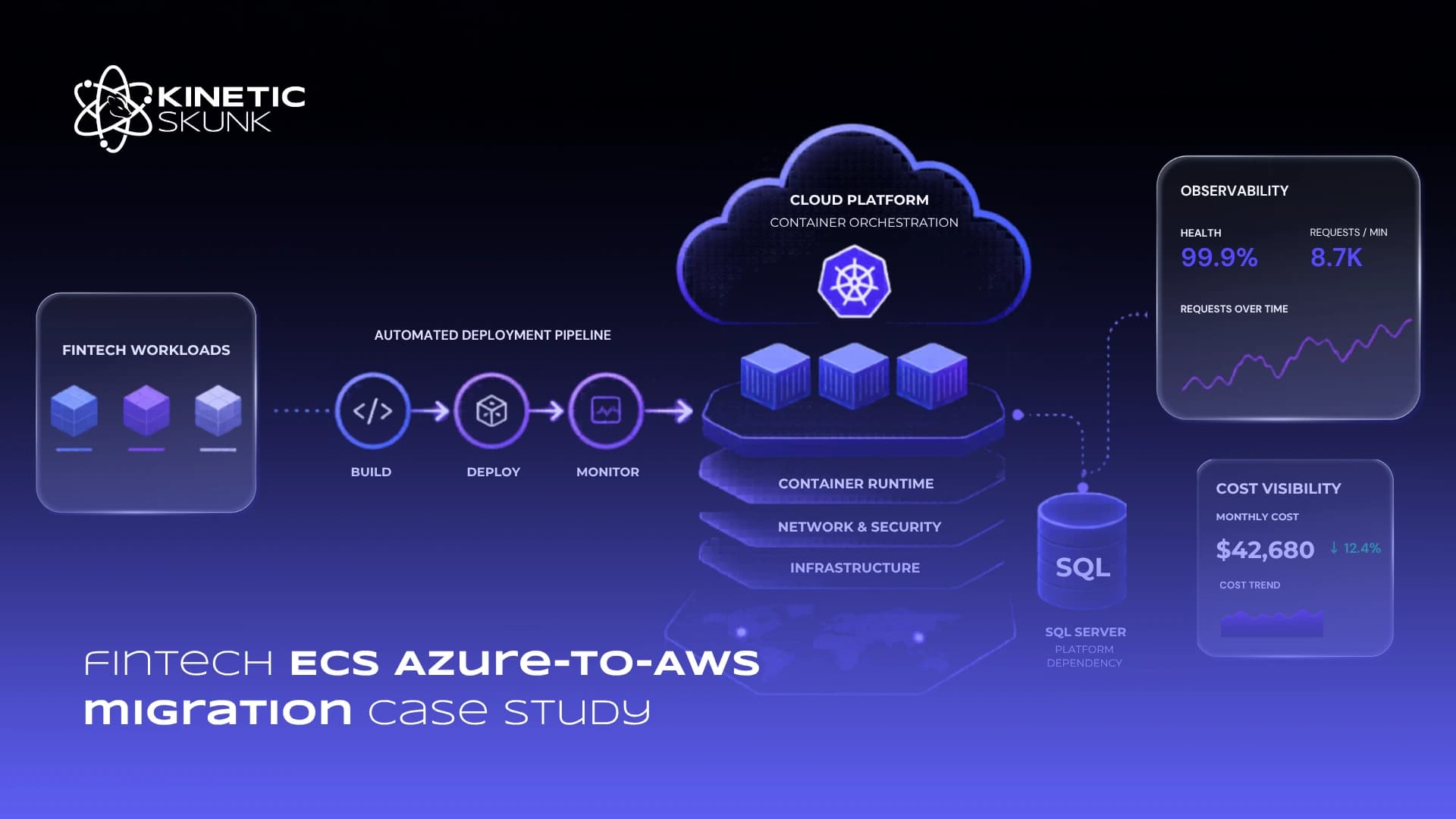
This case study covers how KineticSkunk migrated a regulated fintech platform from Azure to AWS ECS, executing a cross-cloud transition that preserved compliance posture while delivering a container-native operating model with improved deployment velocity and scaling characteristics.
The fintech client had outgrown its Azure-native architecture. Deployment complexity was increasing, costs were difficult to predict, and the engineering team needed container orchestration capabilities better served by AWS ECS and the broader AWS financial services ecosystem.
Use this approach when a fintech or regulated platform needs to move between cloud providers without disrupting production services, and the target architecture requires managed container orchestration with mature compliance and security tooling.
Why it matters
Risks
- Cross-cloud migrations expose regulated workloads to compliance gaps if control mappings between providers are incomplete or untested.
- Big-bang cloud migrations risk extended downtime and data integrity issues for platforms processing financial transactions.
- Teams unfamiliar with the target cloud face operational blind spots that surface as incidents during and after migration.
Costs
- Running parallel cloud infrastructure during migration inflates hosting costs unless the transition is tightly time-boxed and planned.
- Rearchitecting applications mid-migration adds engineering effort and delays the benefits the cloud move was meant to deliver.
- Compliance re-certification on a new platform consumes audit cycles and diverts engineering from product delivery.
Operational impact
- Deployment pipelines built for one cloud provider require redesign when moving to another, temporarily slowing release velocity.
- Monitoring and alerting configurations do not transfer between cloud providers, creating observability gaps during and after migration.
- Team skills and operational runbooks need updating for the new platform, requiring investment in knowledge transfer and training.
Strategic impact
- Fintech competitors already operating on AWS ECS access the broader AWS financial services ecosystem, including compliance-ready managed services.
- Container-native platforms attract engineering talent who expect modern orchestration tooling and deployment practices.
- A successful cross-cloud migration demonstrates platform maturity and operational resilience to regulators and investors.
How KineticSkunk delivered the fintech cross-cloud migration to AWS ECS
Platform assessment and compliance control mapping
- The fintech platform ran on Azure-native services with compliance controls designed around Azure-specific capabilities and configurations.
- KineticSkunk mapped every compliance control to its AWS equivalent, identifying gaps that required new implementations and controls that transferred directly.
- A risk-assessed migration plan prioritised workloads by regulatory sensitivity, starting with non-critical services before progressing to transaction processing.
AWS ECS architecture design and networking
- ECS clusters were designed with Fargate launch type to eliminate infrastructure management overhead for the fintech engineering team.
- VPC architecture, security groups, and network segmentation replicated the isolation posture the platform maintained on Azure.
- AWS PrivateLink and VPC endpoints secured communication between ECS tasks and managed services without traversing public networks.
Phased migration and dual-cloud operation
- Non-critical services migrated first, validating the ECS architecture and CI/CD pipelines before regulated workloads followed.
- DNS-based traffic routing allowed gradual cutover between Azure and AWS, with rollback capability maintained at every phase.
- Compliance validation ran continuously during the dual-cloud period, confirming controls remained effective throughout the transition.
Outcomes and operational improvements
- The fintech platform completed migration to AWS ECS with zero compliance findings and no disruption to transaction processing.
- Deployment complexity reduced as the team moved from Azure-specific tooling to container-native CI/CD pipelines on AWS.
- ECS Fargate auto-scaling provided elastic capacity for transaction volume peaks without the manual capacity planning required on the previous platform.
- The migration established a container-native foundation that supports future service additions without requiring further platform rework.
Common mistakes
Attempting to lift-and-shift Azure-native services directly without rearchitecting for ECS
Consequence: Azure-specific patterns do not map cleanly to ECS task definitions, resulting in workarounds that add complexity and undermine the benefits of the migration.
Avoidance: Design for ECS from the start, containerising workloads to run natively on Fargate rather than replicating Azure service configurations in AWS.
Treating compliance control migration as a post-migration activity
Consequence: Production workloads run without verified controls during the transition period, creating regulatory exposure and potential audit findings.
Avoidance: Map and validate compliance controls before migrating each workload, ensuring continuous adherence throughout the transition.
Skipping the dual-cloud phase to accelerate the migration timeline
Consequence: Without rollback capability, any issue during cutover forces forward-only resolution under pressure, risking extended downtime for regulated services.
Avoidance: Maintain dual-cloud operation with DNS-based routing until each workload is validated on AWS, keeping rollback available at every phase.
Best practices
- Map compliance controls between source and target cloud before migrating any regulated workload.
- Design ECS task definitions from scratch rather than translating Azure-specific configurations.
- Migrate non-critical services first to validate infrastructure, pipelines, and operational runbooks.
- Maintain rollback capability through DNS-based routing during every migration phase.
- Validate monitoring and alerting on AWS before decommissioning Azure observability.
- Update operational runbooks and conduct team training before each workload phase.
Tools and processes
- AWS ECS (Fargate) for managed container orchestration without infrastructure management
- AWS CodePipeline and CodeBuild for container-native CI/CD integrated with ECR
- AWS Config and Security Hub for continuous compliance monitoring of migrated workloads
- Amazon CloudWatch and Container Insights for service-level observability
- AWS PrivateLink and VPC endpoints for secure inter-service communication
How to get started
- Audit the existing Azure architecture and document every compliance control with its implementation detail.
- Map compliance controls to AWS equivalents and identify gaps requiring new implementations.
- Design the target ECS architecture with Fargate, VPC networking, and security group isolation.
- Build CI/CD pipelines for container image building, scanning, and deployment to ECS.
- Migrate non-critical services first, validate operations, then progress to regulated workloads.
- Decommission Azure infrastructure once all production traffic is confirmed stable on AWS ECS.
If compliance continuity is the primary concern, start with control mapping and validation tooling on AWS. If deployment velocity is the immediate goal, start with CI/CD pipeline redesign for ECS. Both paths converge on a fully migrated, compliant fintech platform running on AWS ECS.
How KineticSkunk helps
KineticSkunk helps fintech organisations execute cross-cloud migrations to AWS with phased delivery, compliance-first planning, and container orchestration expertise that reduces risk and accelerates time to value.
The client gained a container-native fintech platform on AWS ECS with continuous compliance, simplified deployments, and elastic scaling, delivered without disruption to regulated services.
When you need help migrating fintech workloads to AWS ECS, contact us or explore more case studies.
Frequently asked questions
Phased migrations typically take three to six months depending on the number of workloads and regulatory complexity, with early non-critical services migrated within the first sprint cycle.
Yes. Control mapping before migration and continuous validation during dual-cloud operation ensures regulatory adherence is never interrupted.
ECS provides simpler managed orchestration with less operational overhead, making it a strong fit for teams who want container benefits without Kubernetes management complexity.
Costs increase temporarily, but tight phase planning and aggressive decommissioning of Azure resources after validation keeps the overlap period short and predictable.