What is it?
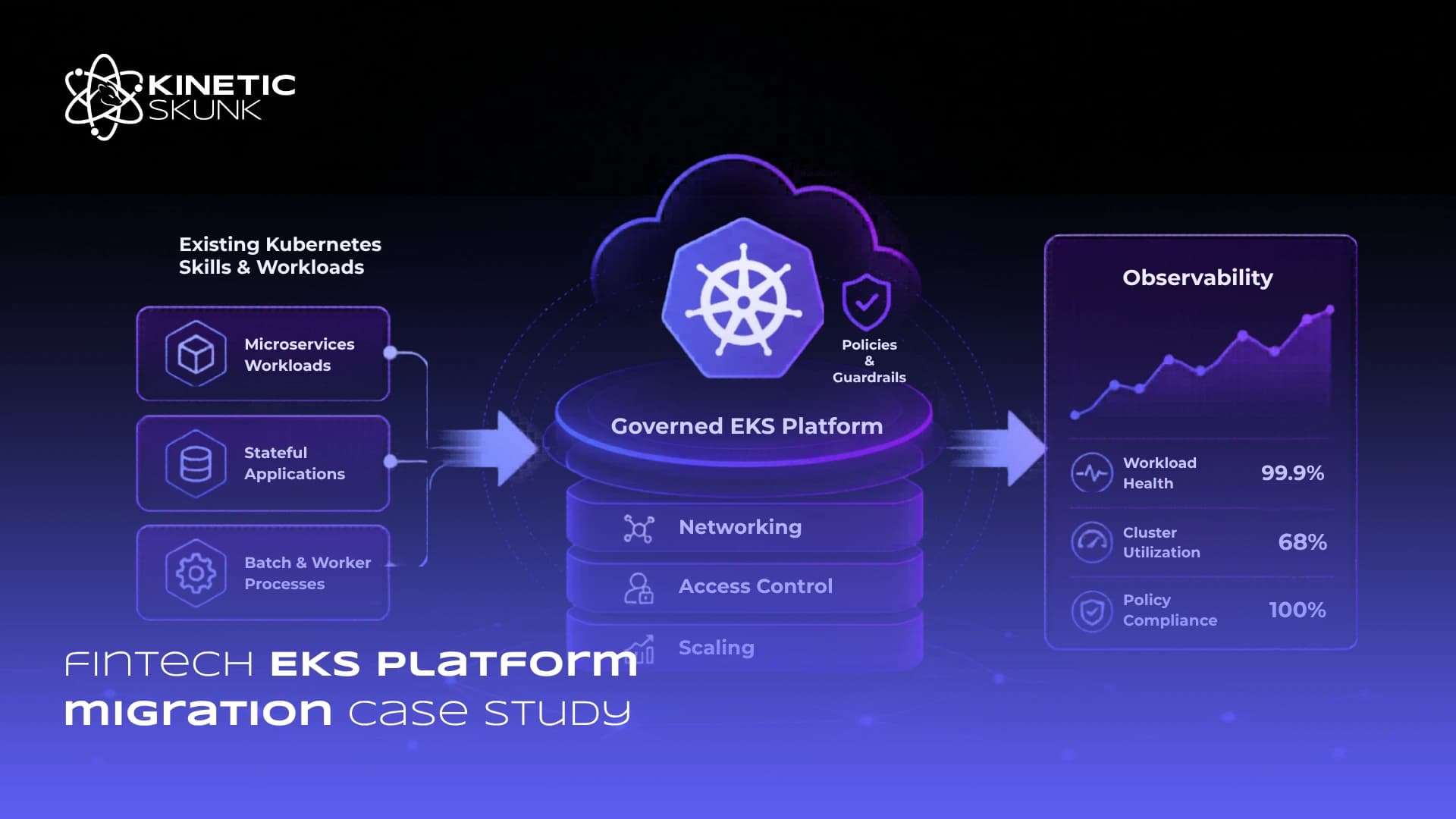
This case study covers how KineticSkunk migrated a fintech platform to Amazon EKS while preserving existing Kubernetes skills and practices, ensuring the engineering team maintained velocity and operational confidence throughout the transition.
The fintech organisation operated Kubernetes workloads on infrastructure that required significant manual effort for upgrades, security patching, and compliance evidence. The team had strong Kubernetes expertise but needed a managed platform that reduced operational overhead without forcing them to learn a fundamentally different orchestration model.
Use this approach when a fintech team already runs Kubernetes effectively but needs managed infrastructure benefits, compliance alignment, and reduced operational toil without disrupting established engineering workflows.
Why it matters
Risks
- Self-managed Kubernetes clusters create patching and upgrade backlogs that accumulate security exposure over time.
- Platform migrations that discard existing team skills introduce productivity drops that delay feature delivery.
- Fintech workloads on unmanaged infrastructure face growing audit scrutiny around control plane governance and access controls.
Costs
- Operating self-managed Kubernetes control planes consumes senior engineering time that could focus on product differentiation.
- Delayed security patches on unmanaged clusters create compliance remediation costs when auditors flag unresolved vulnerabilities.
- Skills retraining for alternative platforms introduces opportunity cost as teams become temporarily less productive.
Operational impact
- Teams managing their own Kubernetes control plane carry on-call burden for cluster upgrades, etcd health, and API server availability.
- Without managed patching, security updates compete with feature work for engineering capacity in every sprint.
- Compliance evidence for self-managed clusters requires manual documentation that managed platforms generate automatically.
Strategic impact
- Fintech competitors on managed Kubernetes ship features faster because they spend less time on undifferentiated infrastructure maintenance.
- Regulatory frameworks increasingly expect documented infrastructure governance that managed platforms provide by design.
- Preserving Kubernetes skills during migration protects the organisation investment in team capability and hiring pipeline.
How KineticSkunk preserved Kubernetes skills during the EKS migration
Skills assessment and migration compatibility analysis
- KineticSkunk mapped the fintech team existing Kubernetes workflows, tools, and operational practices to identify what would transfer directly to EKS.
- The assessment confirmed that Helm charts, RBAC policies, namespace patterns, and CI/CD pipeline integrations required minimal adaptation for the managed platform.
- A compatibility matrix documented which practices would carry over unchanged, which needed minor adjustment, and which would be replaced by AWS-managed equivalents.
Phased workload migration with skills continuity
- Workloads migrated in phases ordered by complexity, starting with stateless API services that validated the team deployment workflows on EKS.
- Each phase included a confidence checkpoint where the team confirmed their existing kubectl, Helm, and monitoring practices worked as expected on the new cluster.
- Production traffic shifted incrementally using weighted routing, ensuring rollback capability at every stage without requiring new operational skills.
CI/CD and tooling alignment
- Existing CI/CD pipelines were reconfigured to target EKS clusters using IAM-based authentication, replacing manual kubeconfig management with AWS-native identity.
- Deployment manifests and Helm values required only cluster endpoint and authentication changes, preserving the team established release processes.
- Monitoring and alerting integrations moved to the new cluster using the same Prometheus and Grafana patterns the team already operated.
Compliance alignment and operational outcomes
- EKS-managed control plane upgrades eliminated the team manual patching burden while providing audit-ready version compliance evidence.
- AWS CloudTrail and EKS audit logs gave the compliance team API-level visibility that previously required custom logging infrastructure.
- The fintech platform gained elastic scaling, managed upgrades, and infrastructure governance without the team needing to learn a different orchestration model.
Common mistakes
Treating EKS migration as a reason to redesign all Kubernetes workflows simultaneously
Consequence: The migration scope expands, timelines slip, and the team faces both platform learning and process change at the same time.
Avoidance: Migrate first with existing workflows intact, then iterate on improvements once the team is comfortable operating on the managed platform.
Ignoring IAM and networking differences between self-managed and EKS clusters
Consequence: Deployments fail in unexpected ways because authentication and network policies behave differently under AWS-managed networking.
Avoidance: Map IAM roles, security groups, and VPC networking before migrating workloads so teams understand the new access model without production pressure.
Migrating all workloads in a single cutover rather than phased validation
Consequence: A single failure blocks the entire migration, and the team cannot demonstrate incremental value to stakeholders or regulators.
Avoidance: Phase migrations by service criticality, validate each phase with the team existing operational practices, and maintain rollback capability throughout.
Best practices
- Map existing Kubernetes workflows to EKS equivalents before migration begins.
- Validate team tools and practices on a non-production EKS cluster before migrating production workloads.
- Use phased migration with weighted routing to maintain rollback capability at every stage.
- Preserve Helm charts and deployment manifests with minimal changes to maintain team familiarity.
- Configure IAM-based cluster authentication early so CI/CD pipelines work before production cutover.
- Document compliance evidence improvements that EKS provides automatically compared to self-managed clusters.
Tools and processes
- Amazon EKS for managed Kubernetes control plane and node lifecycle
- Helm for deployment packaging and release management continuity
- AWS IAM and IRSA for cluster authentication replacing manual kubeconfig management
- CloudTrail and EKS audit logs for compliance evidence and API visibility
- Prometheus and Grafana for monitoring continuity across the migration
How to get started
- Audit existing Kubernetes workflows, tools, and operational practices for EKS compatibility.
- Provision a non-production EKS cluster and validate team tooling against it.
- Migrate the first batch of stateless services and confirm deployment workflows operate as expected.
- Configure IAM-based authentication for CI/CD pipelines and developer access.
- Phase remaining workloads to production EKS with weighted routing and rollback capability.
- Decommission self-managed cluster infrastructure once all services run on EKS.
If the primary driver is compliance, start with IAM integration and audit logging on EKS so evidence generation improves immediately. If the driver is operational overhead, start with control plane migration to eliminate manual upgrade and patching burden. Both paths converge on a fully managed, skills-preserving platform.
How KineticSkunk helps
KineticSkunk helps fintech organisations migrate to Amazon EKS while preserving their team existing Kubernetes skills, maintaining deployment velocity, and strengthening compliance posture without the productivity disruption of platform retraining.
The fintech team gained managed control plane benefits, automated compliance evidence, and elastic scaling while continuing to use the Kubernetes skills, tools, and practices they had already mastered.
When you need help migrating fintech platforms to Amazon EKS while preserving team Kubernetes skills, contact us or explore more case studies.
Frequently asked questions
No. EKS uses standard Kubernetes APIs so existing kubectl, Helm, and CI/CD workflows transfer with minimal changes to cluster endpoints and authentication.
Phased migrations typically complete within three to five months depending on workload count and compliance requirements, with production value delivered in early phases.
The control plane becomes AWS-managed, authentication shifts to IAM, and networking uses VPC-native patterns. Application manifests and team workflows remain largely unchanged.
Yes. EKS provides managed patching, audit logging via CloudTrail, and infrastructure governance controls that simplify evidence generation for regulators and auditors.