What is it?
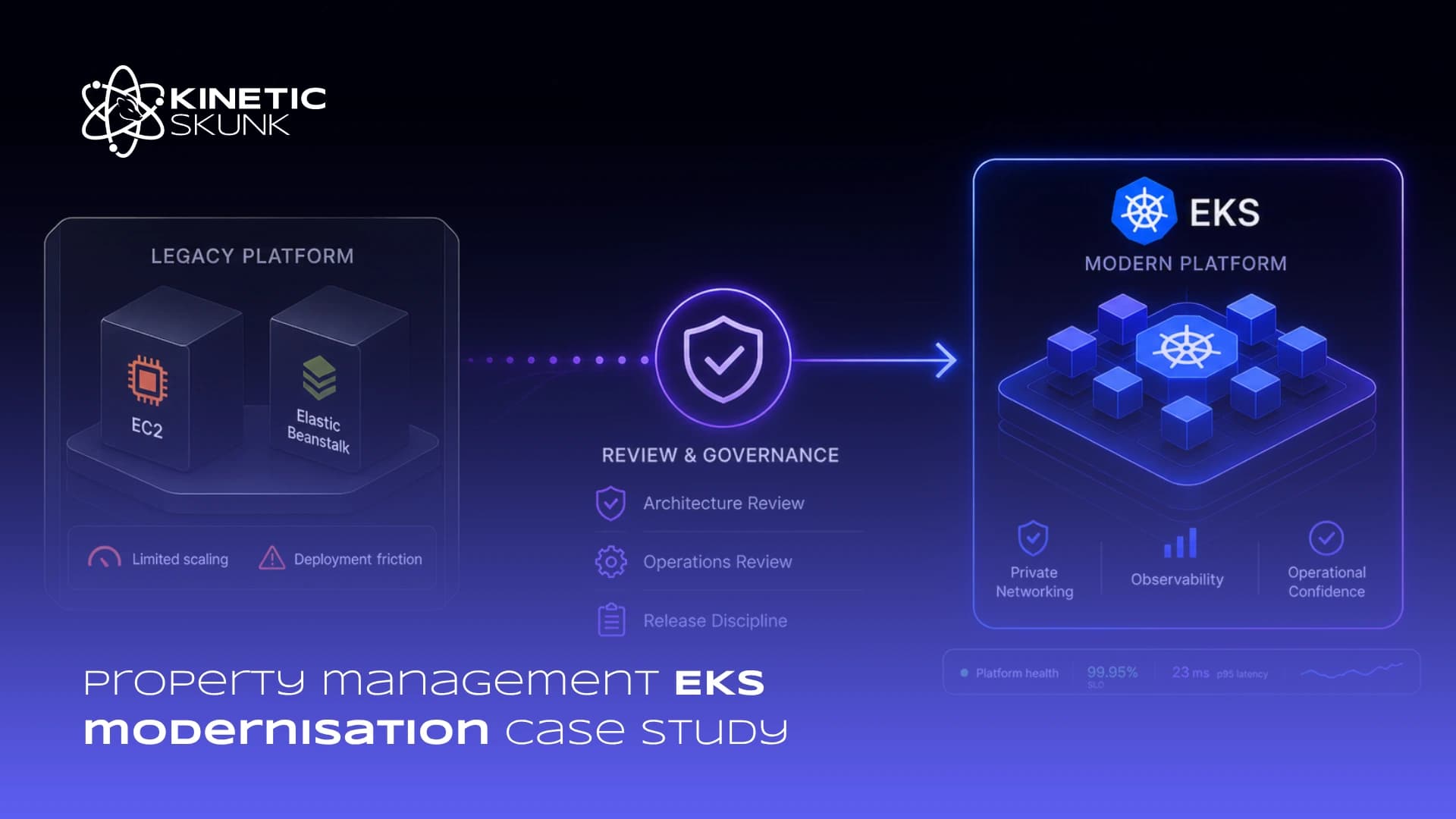
This case study covers how KineticSkunk modernised a property management platform by migrating from legacy infrastructure to Amazon EKS, introducing container orchestration that improved deployment reliability, scaling, and operational control.
The property management team operated a platform serving multiple tenants across residential and commercial portfolios. Legacy infrastructure created deployment bottlenecks, inconsistent environments, and scaling limitations that threatened platform reliability as the client portfolio grew.
Use this approach when a property technology platform has outgrown its legacy hosting, needs elastic scaling for variable tenant workloads, and requires deployment automation that supports rapid feature delivery without operational risk.
Why it matters
Risks
- Legacy infrastructure creates deployment bottlenecks that slow feature delivery and increase the risk of failed releases.
- Manual scaling processes cannot respond fast enough to demand spikes from seasonal property market activity.
- Environment inconsistency between development and production causes defects that only surface after deployment.
Costs
- Over-provisioned legacy servers inflate hosting costs during quiet periods without providing elasticity during peaks.
- Manual deployment coordination consumes engineering time that could be directed toward tenant-facing feature development.
- Incident recovery on legacy infrastructure takes longer, extending downtime costs for property managers and tenants.
Operational impact
- Teams relying on legacy deployment paths cannot adopt continuous delivery practices that modern property platforms demand.
- Without container orchestration, service dependencies remain tightly coupled, making partial deployments risky.
- Knowledge of legacy deployment procedures concentrates in individuals, creating single points of failure for the operations team.
Strategic impact
- Property technology competitors with modern platforms ship features faster and offer better uptime guarantees to landlords and agents.
- Managed Kubernetes reduces the operational burden so engineering can focus on property domain problems rather than infrastructure maintenance.
- Container orchestration establishes a foundation for microservices decomposition as the platform grows in scope and tenant count.
How KineticSkunk modernised the property platform with Amazon EKS
Legacy platform assessment and migration planning
- The property platform ran on legacy infrastructure with manual deployment processes that created release bottlenecks.
- KineticSkunk assessed the existing architecture to identify workloads suitable for containerisation and services that needed refactoring before migration.
- A phased migration plan prioritised high-value services that would benefit most from container orchestration and elastic scaling.
Amazon EKS cluster design and provisioning
- EKS clusters were designed around the property platform workload profile, with node groups sized for baseline demand and auto-scaling configured for peak periods.
- Networking, security groups, and IAM roles were configured to isolate tenant workloads while maintaining operational access for the engineering team.
- Container images were built and stored in Amazon ECR, providing a secure registry integrated with the deployment pipeline.
Containerisation and deployment automation
- Application services were containerised incrementally, starting with stateless API services before progressing to more complex workloads.
- CI/CD pipelines automated image building, vulnerability scanning, and deployment to EKS across development, staging, and production environments.
- Kubernetes manifests and Helm charts provided declarative deployment definitions that eliminated environment drift between stages.
Outcomes and operational improvements
- Deployment frequency increased as the team gained confidence in automated, repeatable release processes.
- Horizontal pod auto-scaling handled demand variability without manual intervention or over-provisioning.
- Operational toil decreased as EKS managed cluster upgrades, node health, and control plane availability.
- The team established a platform foundation that supports future service decomposition without requiring another infrastructure migration.
Common mistakes
Attempting to containerise all services simultaneously rather than migrating incrementally
Consequence: The migration stalls because complex stateful services block progress, and the team cannot demonstrate value until everything moves together.
Avoidance: Start with stateless API services that containerise cleanly, demonstrate value early, and build migration confidence before tackling complex workloads.
Sizing EKS node groups for peak demand rather than configuring auto-scaling
Consequence: Infrastructure costs remain high during quiet periods, negating one of the key benefits of moving to managed Kubernetes.
Avoidance: Configure cluster auto-scaler and horizontal pod auto-scaling from the start so the platform scales with actual demand rather than worst-case assumptions.
Treating Kubernetes adoption as purely an infrastructure change without updating team practices
Consequence: Teams continue manual deployment habits on the new platform, losing the deployment velocity and reliability benefits that container orchestration enables.
Avoidance: Pair infrastructure migration with CI/CD pipeline automation and team upskilling so deployment practices evolve alongside the platform.
Best practices
- Assess legacy workloads for containerisation readiness before committing to a migration timeline.
- Design EKS clusters with auto-scaling from the start rather than retrofitting elasticity later.
- Use a phased migration approach, starting with stateless services that containerise cleanly.
- Integrate CI/CD pipelines with EKS early so deployment automation improves incrementally.
- Define resource requests and limits for each service to prevent noisy-neighbour issues.
- Maintain environment parity between development, staging, and production using declarative Kubernetes manifests.
Tools and processes
- Amazon EKS for managed Kubernetes orchestration and cluster lifecycle
- Amazon ECR for container image storage and vulnerability scanning
- CI/CD pipelines for automated build, test, and deployment to EKS
- Helm charts for declarative, repeatable service deployment across environments
- Cluster auto-scaler and horizontal pod auto-scaling for elastic workload management
How to get started
- Audit the existing property platform architecture to identify services suitable for containerisation.
- Design EKS cluster topology with node groups, networking, and security appropriate for the workload profile.
- Containerise the first batch of stateless services and establish CI/CD pipelines for automated deployment.
- Configure auto-scaling policies based on observed demand patterns from the legacy platform.
- Migrate remaining services incrementally, validating each phase against reliability and performance baselines.
- Decommission legacy infrastructure once all production traffic runs on EKS.
If the immediate pressure is deployment reliability, start with CI/CD pipeline automation and the first containerised services on EKS. If the blocker is infrastructure cost, start with auto-scaling configuration and workload right-sizing. Both paths converge on a fully modernised property platform.
How KineticSkunk helps
KineticSkunk helps property technology organisations migrate from legacy infrastructure to Amazon EKS with phased container adoption, deployment automation, and operational practices that reduce risk and accelerate feature delivery.
The client gained a scalable, cost-efficient property platform where deployments are automated, scaling is elastic, and the engineering team focuses on tenant-facing features rather than infrastructure maintenance.
When you need help modernising property platforms with Amazon EKS, contact us or explore more case studies.
Frequently asked questions
EKS removes the operational burden of managing the Kubernetes control plane, upgrades, and patching, so the team focuses on application workloads rather than cluster maintenance.
Phased migrations typically take three to six months depending on service count and complexity, with early value delivered within the first sprint cycle.
Auto-scaling means the platform only consumes resources proportional to demand, reducing over-provisioning costs common with fixed legacy infrastructure.
Yes. Most CI/CD tools support Kubernetes deployment targets, and KineticSkunk configures pipelines for automated image build, scanning, and EKS rollout.