What is it?
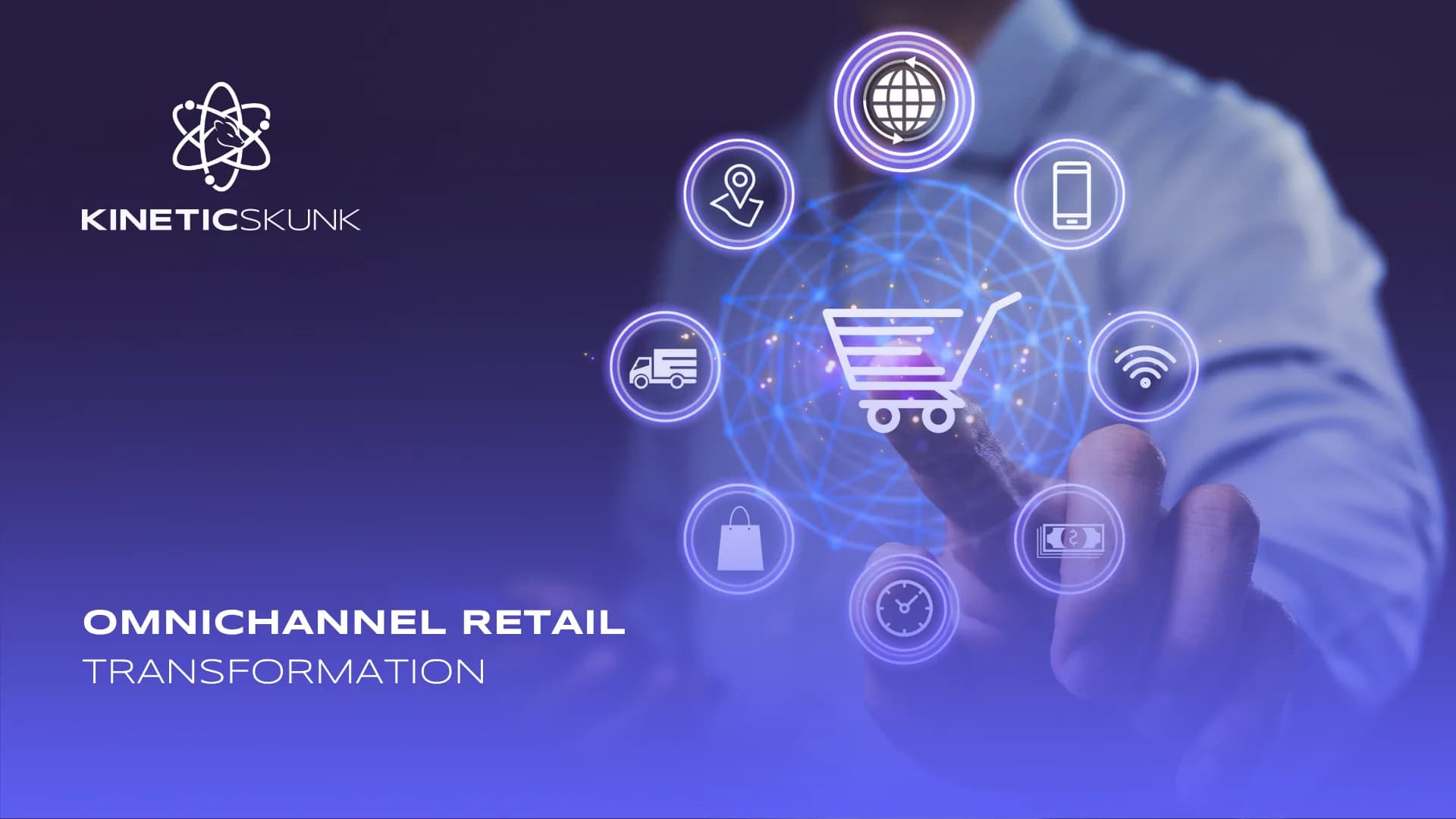
This case study covers how KineticSkunk delivered an omnichannel retail transformation, replacing disconnected point-of-sale, e-commerce, and warehouse systems with a unified commerce platform that synchronises inventory, orders, and customer data across physical and digital channels.
The retailer operated separate systems for in-store sales, online orders, and warehouse management. Stock counts diverged, customers experienced different pricing and availability depending on channel, and fulfilment errors eroded margin and trust.
Use this approach when a retailer needs to unify commerce operations across physical stores, digital channels, and fulfilment centres into a cohesive platform that delivers consistent customer experiences and accurate inventory.
Why it matters
Risks
- Disconnected inventory systems create overselling on digital channels when in-store purchases reduce available stock without real-time synchronisation.
- Inconsistent customer experiences across channels erode brand trust and push shoppers toward competitors with seamless cross-channel journeys.
- Fulfilment errors from stock inaccuracy generate returns, refunds, and customer service load that directly impact margin.
Costs
- Maintaining separate technology stacks for each channel multiplies licensing, integration, and operational support costs without proportional value.
- Manual stock reconciliation between systems consumes staff time that could serve customers or improve merchandising decisions.
- Lost sales from out-of-stock visibility gaps cost more than the technology investment required to unify inventory data.
Operational impact
- Without unified order management, click-and-collect and ship-from-store workflows depend on manual coordination between channels.
- Separate customer databases per channel prevent personalisation and make loyalty programmes inconsistent across touchpoints.
- Testing fragmented across channel-specific systems misses integration failures that only surface when customers move between channels.
Strategic impact
- Competitors with unified commerce platforms respond faster to demand shifts because they see inventory and customer behaviour holistically.
- Omnichannel capability becomes a prerequisite for retail partnerships and marketplace integrations that drive incremental revenue.
- A single commerce platform provides the data foundation for AI-driven personalisation, demand forecasting, and dynamic pricing.
How KineticSkunk delivered the omnichannel retail transformation
Commerce landscape assessment and unification strategy
- The retailer operated point-of-sale, e-commerce, and warehouse management as independent systems with batch synchronisation that introduced stock accuracy delays.
- KineticSkunk assessed the commerce landscape, mapping data flows between channels and identifying where disconnection caused customer-facing failures.
- A phased unification strategy prioritised inventory synchronisation first, followed by order management consolidation and customer profile unification.
Unified inventory and real-time stock synchronisation
- A central inventory service replaced batch feeds with event-driven stock updates that propagated changes across all channels within seconds.
- Store-level stock movements, online purchases, and warehouse receipts all wrote to the same inventory record, eliminating divergence between channel views.
- Safety stock rules and allocation logic ensured that high-demand items remained available across channels without manual intervention from merchandising teams.
Cross-channel order management and fulfilment
- Unified order management enabled click-and-collect, ship-from-store, and endless aisle scenarios that previously required manual coordination.
- Routing logic selected the optimal fulfilment location based on proximity, stock availability, and operational capacity rather than defaulting to a single warehouse.
- Payment and refund flows were standardised across channels so customers received consistent treatment regardless of where they purchased or returned.
Testing, resilience, and outcomes
- End-to-end testing spanned devices, payment gateways, inventory events, and fulfilment workflows rather than validating each channel in isolation.
- Resilience testing confirmed that a failure in one channel, such as a point-of-sale outage, did not cascade into lost orders or inconsistent pricing on other channels.
- The transformation gave the retailer a single view of customers and stock, reduced fulfilment errors, and enabled new revenue streams through cross-channel capabilities.
- Operational teams gained confidence that promotions, pricing changes, and stock movements would behave consistently wherever customers engaged.
Common mistakes
Treating omnichannel as a front-end problem without unifying back-end systems
Consequence: A consistent storefront masks divergent inventory and order data underneath, leading to fulfilment failures that surface only after the customer has committed to a purchase.
Avoidance: Start with back-end unification of inventory and order management before harmonising the customer-facing experience across channels.
Testing channels independently without cross-channel integration scenarios
Consequence: Each channel passes its own tests while integration failures between channels only appear in production when customers attempt cross-channel workflows.
Avoidance: Design test scenarios that exercise journeys spanning multiple channels, including click-and-collect, ship-from-store, and cross-channel returns.
Launching unified commerce without resilience planning for channel failures
Consequence: Tight coupling between channels means a point-of-sale outage can prevent online order processing or corrupt shared inventory records.
Avoidance: Design circuit breakers and graceful degradation so each channel continues operating independently when another channel experiences disruption.
Best practices
- Map all data flows between channels and identify where batch synchronisation introduces accuracy gaps.
- Implement event-driven inventory updates that propagate stock changes to all channels within seconds.
- Unify order management so fulfilment routing can optimise across stores and warehouses.
- Standardise payment and refund processing across channels for consistent customer treatment.
- Test cross-channel journeys end-to-end, not just individual channel workflows in isolation.
- Plan resilience for channel-level failures so one outage does not cascade across the commerce estate.
Tools and processes
- Event-driven inventory synchronisation for real-time stock accuracy across channels
- Unified order management with intelligent fulfilment routing
- Cross-channel customer profile consolidation for personalisation
- End-to-end testing across devices, payments, and fulfilment paths
- Circuit breaker patterns for channel-level resilience and graceful degradation
How to get started
- Audit the current commerce landscape, documenting systems, data flows, and synchronisation gaps across channels.
- Prioritise inventory unification with event-driven stock updates as the foundation for cross-channel accuracy.
- Consolidate order management to enable click-and-collect, ship-from-store, and unified fulfilment routing.
- Unify customer profiles across channels to enable consistent personalisation and loyalty.
- Implement cross-channel testing that exercises journeys spanning physical and digital touchpoints.
- Add resilience patterns that allow channels to operate independently during partial outages.
If stock accuracy is the primary pain point, start with inventory synchronisation. If customer experience inconsistency drives churn, start with customer profile unification. Both paths converge on a unified commerce platform with real-time visibility and operational resilience.
How KineticSkunk helps
KineticSkunk helps retailers unify commerce operations with phased delivery that reduces risk while building toward a fully integrated omnichannel platform.
The retailer gained unified inventory visibility, consistent cross-channel experiences, and fulfilment accuracy that eliminated overselling and reduced operational support costs.
When you need help unifying your retail channels, contact us or explore more case studies.
Frequently asked questions
Phased delivery typically spans four to eight months, with inventory unification delivered first and cross-channel capabilities added incrementally as each foundation layer stabilises.
Yes. A phased approach allows existing point-of-sale and e-commerce systems to continue operating while unified services are built alongside and traffic is migrated gradually.
Data quality gaps between legacy systems can propagate incorrect inventory or customer records into the unified platform if not addressed with reconciliation and validation during migration.
Not necessarily. Integration layers can unify data and workflows across existing systems while replacing only the components that cannot support real-time synchronisation requirements.