What is it?
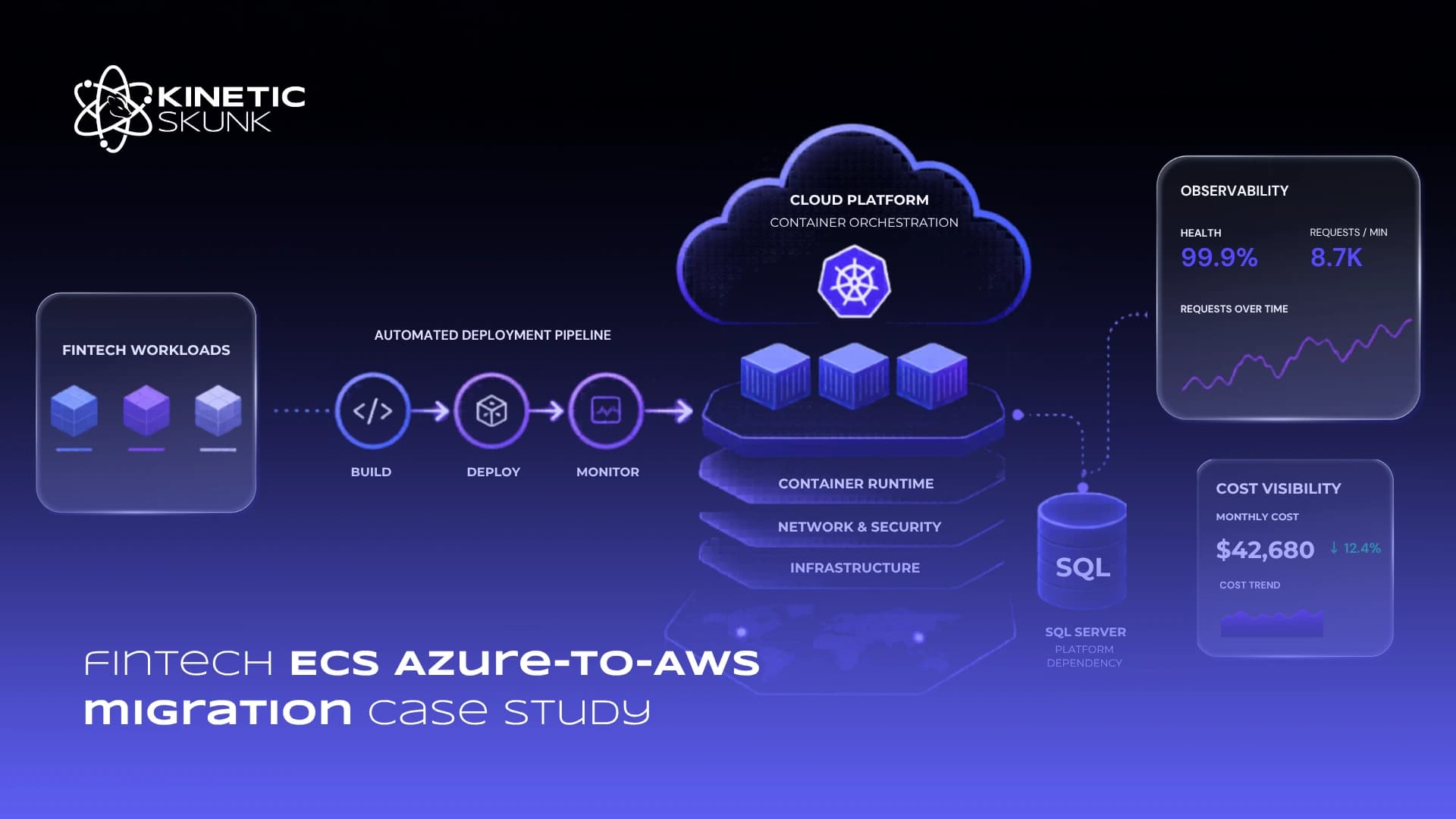
This case study covers how KineticSkunk transformed a FinTech deployment pipeline from manual, snowflake-cluster releases to automated AWS ECS pipelines with immutable task definitions, centralised secrets, and observability tied to user journeys.
The client needed to accelerate release cadence while satisfying finance and risk teams that faster flow would not trade away compliance controls. Manual deploys and bespoke runbooks were scaling linearly with team size, creating bottlenecks near peak trading periods.
Use this approach when a regulated team outgrows manual container deployments, needs evidence that speed does not weaken controls, and wants a path that scales engineers without multiplying bespoke runbooks.
Why it matters
Risks
- Manual deploys and snowflake clusters introduce human error into production changes, especially under peak-period pressure.
- Without immutable rollouts, partial deployments can leave services in inconsistent states that are difficult to diagnose.
- Scattered secrets and ad-hoc networking rules create compliance gaps that surface during audits.
Costs
- Engineering time spent on manual deployment coordination diverts resources from product delivery.
- Snowflake clusters with idle capacity inflate infrastructure spend without proportional throughput.
- Incident recovery without automated rollback extends downtime and increases remediation cost.
Operational impact
- Bespoke runbooks per service multiply linearly with team growth, creating knowledge silos and onboarding delays.
- Without observability tied to user journeys, teams optimise for CPU graphs rather than customer experience.
- Operators avoid deploying near peak because rollback is untested and risky.
Strategic impact
- Finance and risk teams block faster release cadence when they cannot see evidence that controls remain intact.
- Competitors who automate deployment pipelines ship features faster and capture market share.
- Scalable deployment patterns enable team growth without proportional increases in operational overhead.
How KineticSkunk completed the ECS deployment acceleration engagement
Throughput versus safety tension
- KineticSkunk assessed the tension between deployment speed and compliance requirements for FinTech-regulated workloads.
- The engagement established guardrails that gave operators confidence to deploy more frequently without weakening the controls that finance and risk teams required.
- Evidence was gathered showing that automated pipelines with health checks are safer than manual processes with ad-hoc verification.
Architecture and guardrails
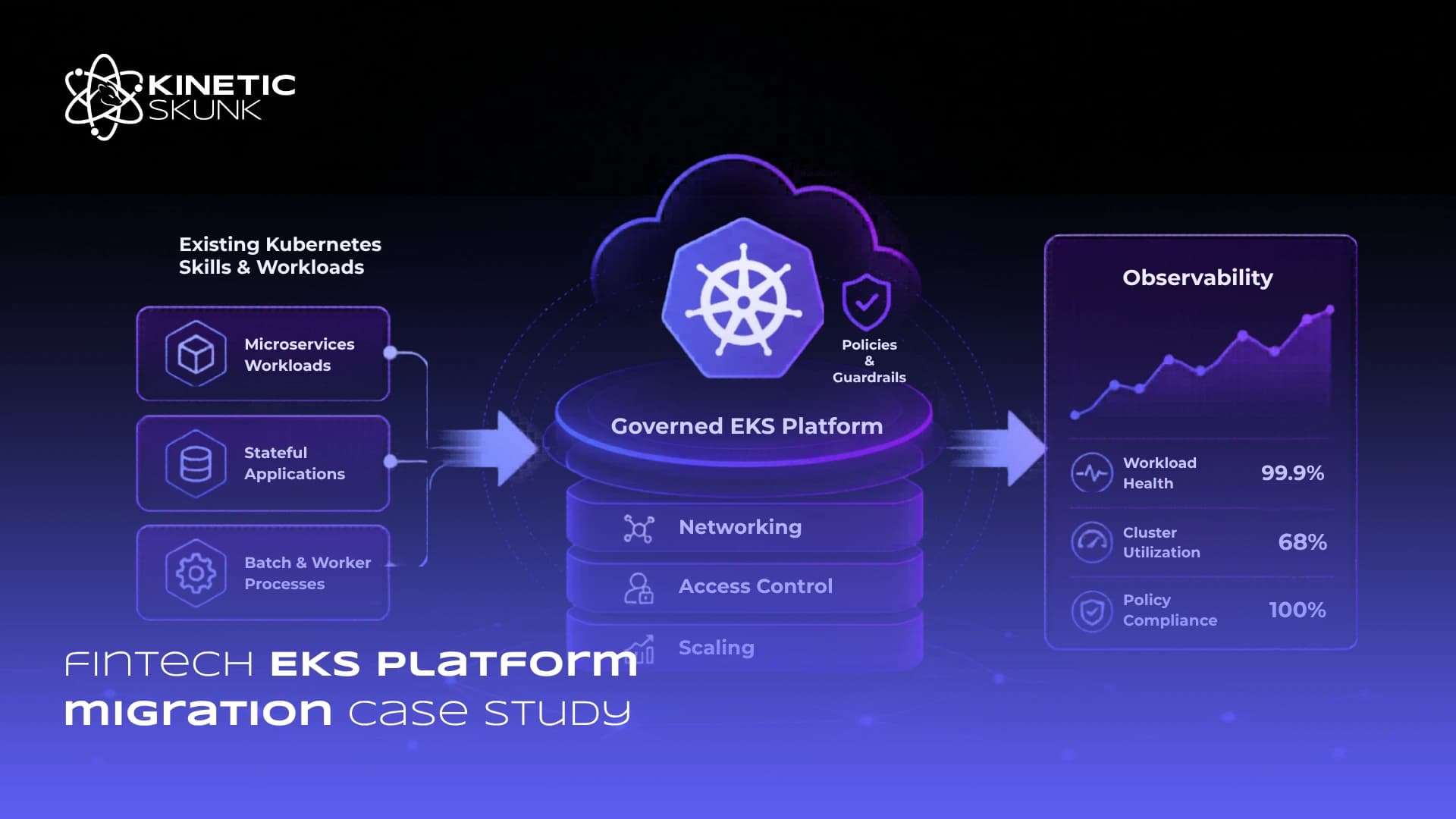
- ECS clusters were redesigned as cattle, not pets, with immutable task definitions that make every deployment reproducible.
- Networking guardrails enforced predictable blast radius through security groups, service discovery, and controlled ingress paths.
- Centralised secrets management via AWS Systems Manager replaced scattered configuration, enabling consistent rotation on audit-aligned schedules.
Pipeline and rollout design
- Automated CI/CD pipelines promote task definitions through environments with diffable, repeatable service updates.
- Health check integration triggers automatic rollback when degradation is detected, removing the need for manual operator intervention.
- Rollback procedures are rehearsed regularly so operators trust the recovery path and deploy with confidence near peak.
Measured outcomes
- Release time dropped 80% by eliminating manual coordination and bespoke deployment steps.
- Infrastructure costs reduced 30% through right-sized ECS tasks and removal of idle snowflake capacity.
- Service dashboards tied to user journeys provide meaningful observability that connects deployment changes to customer impact.
Common mistakes
Treating ECS clusters as unique snowflakes rather than cattle
Consequence: Each cluster accumulates drift, making deployments unpredictable and rollback unreliable because no two environments behave identically.
Avoidance: Define all ECS resources through immutable task definitions in code so every deployment is reproducible and every cluster is replaceable.
Skipping rollback rehearsals because the deploy pipeline looks reliable
Consequence: When a real failure occurs near peak, operators hesitate to roll back because the recovery path is untested, extending downtime.
Avoidance: Schedule regular rollback rehearsals as part of the deployment process, not as an afterthought, so recovery confidence stays high.
Spreading secrets across task definitions and environment files without centralisation
Consequence: Configuration drift between services makes rotation error-prone, audit evidence incomplete, and incident diagnosis slower.
Avoidance: Centralise secrets in AWS Systems Manager Parameter Store and grant ECS tasks least-privilege access via IAM roles.
Best practices
- Automate task definitions and service updates so promotions are repeatable and diffable.
- Centralise secrets and rotate them on a schedule that matches your audit story.
- Keep service dashboards tied to user journeys, not only CPU graphs.
- Rehearse rollbacks on a regular cadence so operators trust the recovery path.
- Use health check integration to trigger automatic rollback on degradation.
- Right-size ECS tasks based on actual workload profiles rather than peak-capacity guessing.
- Keep networking guardrails explicit through security groups and controlled ingress.
Tools and processes
- AWS ECS with Fargate or EC2 launch types for container orchestration
- AWS Systems Manager Parameter Store for centralised secrets management
- CI/CD pipelines with automated task definition promotion and health check gates
- CloudWatch and custom dashboards aligned to user-journey metrics
- Security groups and service discovery for controlled networking
How to get started
- Audit current deployment processes for manual steps, snowflake clusters, and scattered secrets.
- Identify the regulatory and compliance constraints that deployment automation must preserve.
- Design immutable ECS task definitions with centralised secrets and networking guardrails.
- Build CI/CD pipelines that promote task definitions through environments with automated health checks.
- Implement observability dashboards tied to user journeys rather than infrastructure-only metrics.
- Schedule and execute rollback rehearsals to validate recovery confidence before peak periods.
- Measure release time, infrastructure cost, and uptime improvements against the manual baseline.
If the immediate pain is deployment speed, start with CI/CD pipeline automation and immutable task definitions. If the blocker is compliance confidence, start with centralised secrets and networking guardrails. Both paths converge on the same target architecture.
How KineticSkunk helps
KineticSkunk helps regulated teams accelerate ECS deployment pipelines while preserving the compliance controls that finance and risk teams require.
The client achieved 80% faster releases, 30% lower infrastructure costs, and 99.95% uptime with deployment patterns that scale team growth without multiplying operational overhead.
When you want help tuning ECS pipelines and guardrails, contact us or read more case studies.
Frequently asked questions
Release time dropped by 80% compared to the manual baseline, with automated task definition promotion and health check gates replacing manual coordination steps.
No. Centralised secrets, networking guardrails, and immutable rollouts strengthened compliance posture while increasing deployment frequency.
Health checks detect degradation and trigger automatic rollback. Rehearsed recovery procedures ensure operators trust the rollback path.
Yes. The patterns apply wherever teams need fast, auditable deployments with predictable blast radius and centralised secrets management.