AWS Managed Services: A Practical Guide for Business Decision-Makers
May 24, 2026
What is the AWS Well-Architected Review?
The AWS Well-Architected Review is not marketing fluff. Instead, it is a practical way to expose cloud risk, wasted spend, weak operations and architecture decisions that could slow your business down.
The AWS Well-Architected Review is a structured way to evaluate cloud workloads against AWS best practices. However, it is not a theoretical exercise, and it should not be treated as a once-off checklist. Done properly, it helps you understand whether your workload is secure, reliable, efficient, cost-effective and sustainable enough to support the business.
At Kinetic Skunk, we see the same pattern often: cloud environments grow quickly, but governance, cost control and operational discipline do not always keep up. As a result, small issues can become expensive problems if they are not reviewed early.
Therefore, let us break down what the review actually covers, why it matters and what to do with the findings.
The six pillars of the AWS Well-Architected Review
The review is built around the AWS Well-Architected Framework. AWS organises the framework around six pillars: Operational Excellence, Security, Reliability, Performance Efficiency, Cost Optimization and Sustainability.
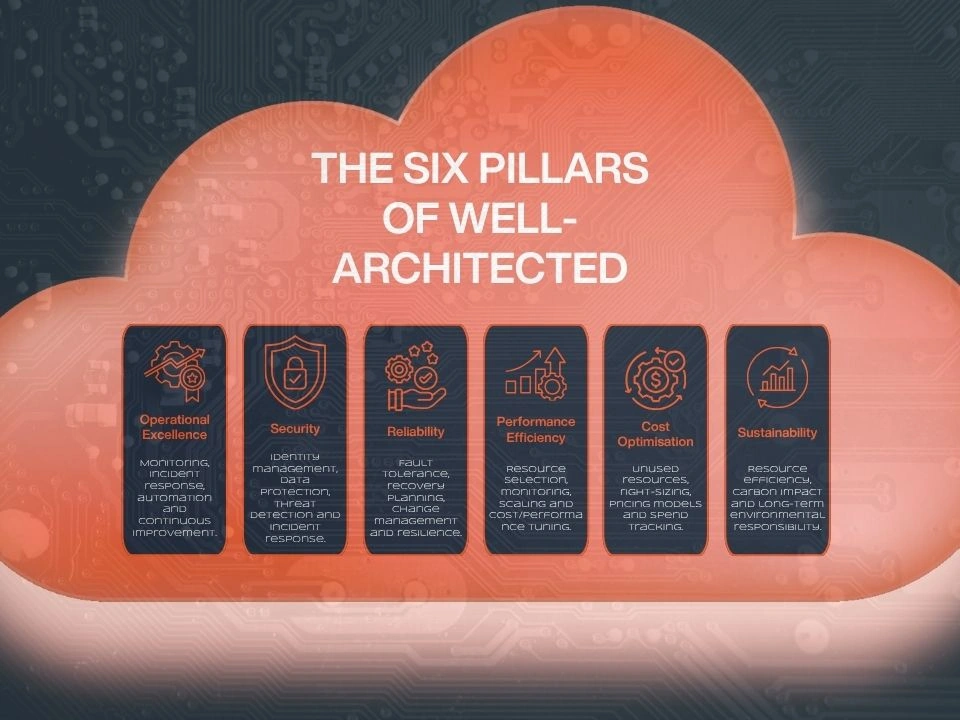
Skunk Tip: Do not treat the six pillars as isolated checkboxes. For example, a weakness in one pillar often creates pressure in another. Poor operations can create security blind spots, while weak architecture can drive up cost. In addition, limited monitoring can hide reliability risk.
Kinetic Truth Bomb: If your cloud environment only looks good when nothing goes wrong, it is not well-architected. It is lucky.
Pillar 1: Operational Excellence
Operational Excellence looks at how well you run, monitor and improve your systems. In practice, this includes observability, incident response, deployment processes, automation, documentation and continuous improvement.
For example, a workload can be well designed on paper and still fail in production if teams cannot operate it effectively. More importantly, this pillar asks whether your team can detect issues, respond quickly, learn from incidents and improve the system over time.
Skunk Tip: Review your monitoring, incident response process and deployment practices before you scale further. Because of this, operational cracks are easier to fix before traffic, complexity and team size increase.
Kinetic Truth Bomb: If no one knows what failed, who owns it or how to recover it, your operations are running on hope.
Pillar 2: Security
Security focuses on protecting data, systems and business assets. However, this is about real risk reduction, not simply ticking compliance boxes.
A strong review should examine identity and access management, data protection, network controls, threat detection, logging, monitoring and incident response. Because of this, security weaknesses often become expensive later because they affect customer trust, regulatory exposure and business continuity.
Skunk Tip: Start with identity. Specifically, review IAM policies, privileged users, unused credentials, logging and encryption. Most serious security problems start with access that is too broad or poorly monitored.
Kinetic Truth Bomb: Security is not something you add after launch. By then, the shortcuts are already baked into the stack.
Pillar 3: Reliability
Reliability asks whether workloads perform as intended and recover quickly from failure. Specifically, this includes fault tolerance, backup strategy, disaster recovery, capacity planning, change management and resilience testing.
In other words, the goal is not to pretend failure will never happen. Instead, the goal is to design workloads that can absorb failure, recover predictably and keep supporting business outcomes.
Skunk Tip: Test recovery before you need it. Therefore, define real RTO and RPO targets, simulate failure and check whether your backup and recovery process actually works.
Kinetic Truth Bomb: A backup you have never restored is not a recovery plan. It is a theory.
Pillar 4: Performance Efficiency
Performance Efficiency focuses on using cloud resources effectively. For example, it examines whether the workload uses the right compute, storage, database and networking services for the job.
In addition, this pillar looks at monitoring, scaling, architecture choices and optimisation. Ultimately, the aim is to meet demand without overprovisioning, underperforming or creating unnecessary complexity.
Skunk Tip: Match the resource to the workload. Rather than throwing bigger instances at a design problem, consider caching, serverless, a managed database or a different architecture pattern.
Kinetic Truth Bomb: If scaling means “buy more compute every time something hurts,” your architecture is sending you a warning.
Pillar 5: Cost Optimization
Cost Optimization is about eliminating waste and making sure cloud spend supports measurable business value. In practice, it looks at unused resources, overprovisioned infrastructure, pricing models, tagging, spend visibility, budget controls and ownership.
In addition, AWS recommends strong Cloud Financial Management practices to help organisations realise business value and financial success as they optimise cost and usage.
Skunk Tip: Tag everything, set budget alerts, review unused resources and make cloud spend visible to the teams creating it. As a result, cost control becomes a habit rather than a quarterly panic.
Kinetic Truth Bomb: If your cloud bill surprises you, it means your architecture, ownership or visibility is already behind.
Pillar 6: Sustainability
Sustainability is now a core AWS Well-Architected pillar. At the same time, it focuses on reducing environmental impact through efficient architecture and responsible resource use.
The AWS Sustainability Pillar provides design principles, operational guidance and best practices for reducing the environmental impact of cloud workloads. As a result, teams can reduce waste while improving workload efficiency.
Ultimately, sustainability is not separate from cost and performance. Efficient workloads usually consume fewer resources, cost less to run and create less waste.
Skunk Tip: Start with waste. For instance, remove idle infrastructure, reduce unnecessary data retention, schedule non-production environments and improve utilisation before chasing complex sustainability reporting.
Kinetic Truth Bomb: Green cloud is not just an ESG line item. Often, it is cleaner architecture, lower waste and better cost discipline.
AWS Well-Architected Review pillar breakdown
To make the six pillars easier to compare, the table below summarises the main focus area for each one.
| Pillar | Core focus |
|---|---|
| Operational Excellence | Monitoring, incident response, automation and continuous improvement |
| Security | Identity management, data protection, threat detection and incident response |
| Reliability | Fault tolerance, recovery planning, change management and resilience |
| Performance Efficiency | Resource selection, monitoring, scaling and cost/performance optimisation |
| Cost Optimization | Eliminating unused resources, right-sizing, pricing models and spend tracking |
| Sustainability | Resource efficiency, carbon impact and long-term environmental responsibility |
How an AWS Well-Architected Review creates value
A useful review should not end with a report that sits in a folder. Instead, it should produce a clear, prioritised improvement plan.
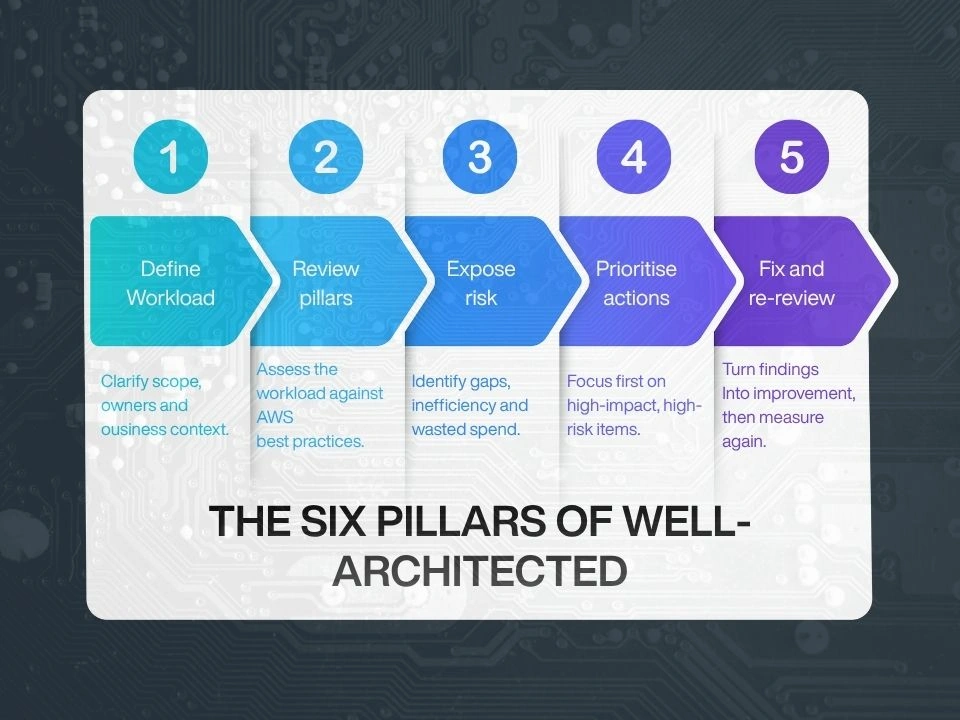
- Define the workload: Clarify the scope, business context, owners and success criteria.
- Review the six pillars: Assess the workload against AWS best practices.
- Expose risk and waste: Identify security gaps, reliability issues, inefficiencies and cost problems.
- Prioritise findings: Focus first on the issues with the highest business impact.
- Fix and re-review: Turn findings into action, then measure improvement over time.
Skunk Tip: Prioritise findings by business risk, not by what is easiest to fix. Start with security, reliability and cost issues that could create the most damage.
Kinetic Truth Bomb: A Well-Architected Review that does not lead to action is just expensive documentation.
Bottom line
The AWS Well-Architected Review is practical, risk-focused and action-oriented. It helps expose the hidden weaknesses that can lead to outages, security gaps, performance issues and runaway cloud bills.
However, the framework is only valuable if you act on the findings. Reviews that sit on a shelf are worthless, while reviews that turn into remediation plans can improve security, reliability, cost control, performance and sustainability.
Therefore, take a breath and then take the next step: review the workload, find the gaps and fix what matters most.
FAQs
What is an AWS Well-Architected Review?
An AWS Well-Architected Review is a structured assessment of a cloud workload against AWS best practices. As a result, teams can identify risk, inefficiency, reliability gaps, performance issues, cost waste and sustainability opportunities.
What are the six pillars of the AWS Well-Architected Framework?
The six pillars are Operational Excellence, Security, Reliability, Performance Efficiency, Cost Optimization and Sustainability. Together, they give teams a structured way to assess workload quality and cloud maturity.
How often should you run an AWS Well-Architected Review?
You should run a review when launching a new workload, after major architecture changes and at regular intervals for critical systems. Because cloud environments change quickly, a once-off review is rarely enough.
Why is Cost Optimization important in a Well-Architected Review?
Cost Optimization helps identify unused resources, overprovisioned infrastructure, weak tagging, poor spend visibility and inefficient architecture choices. Therefore, it ensures cloud spend is tied to measurable business value.
Is Sustainability really part of the AWS Well-Architected Review?
Yes. Sustainability is one of the six AWS Well-Architected pillars. In practice, it focuses on efficient architecture, responsible resource use and reducing the environmental impact of cloud workloads.
What next?
- Explore our AWS Solutions here.
- Read our AWS Delivery model here.
- Explore our Cloud Without Chaos series here.
- Read AWS guidance on building a business case for cloud migration here.